

HDI Trimer in 2K Polyurethane Clearcoats: Practical Formulation Behavior
Oct 16, 2026
HDI Trimer in 2K Polyurethane Clearcoats: Formulation Behavior and Selection Points
HDI trimer, CAS 28182-81-2, occupies a specific position in the 2K polyurethane coatings toolbox. It is not the cheapest crosslinker. It is not the fastest. But when a coating must stay clear and glossy through years of outdoor exposure, HDI trimer is often the default choice - and the reasons come down to molecular structure, not marketing.
This article looks at HDI trimer from a formulator's perspective: how its isocyanurate ring behaves differently from HDI biuret, what that means for clearcoat formulation, and where the selection decisions actually matter. For baseline product specifications, see the HDI Trimer (CAS 28182-81-2) product page.
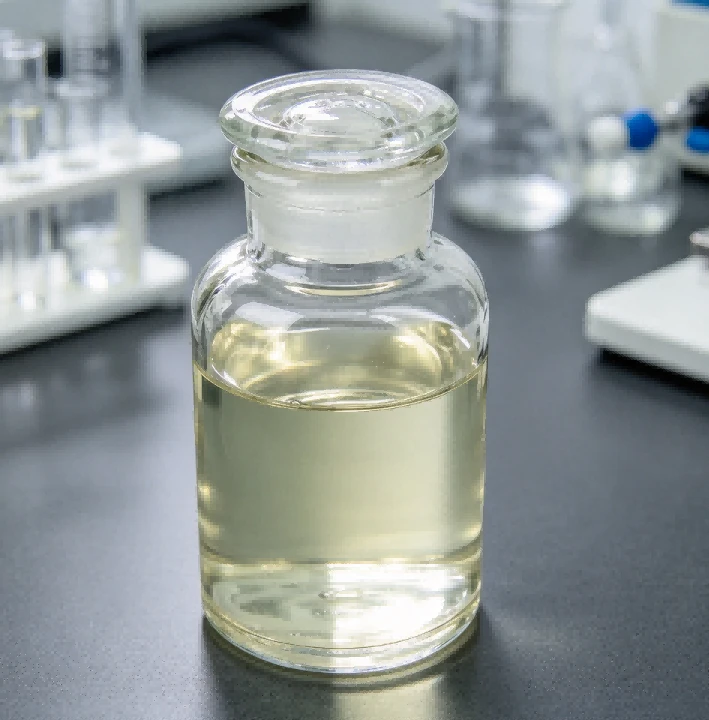
HDI trimer, CAS 28182-81-2, supplied as a clear liquid with 100% solids. Schematic illustration. Actual product appearance may vary.
The Isocyanurate Ring: Why It Matters
HDI trimer is built around a six-membered isocyanurate ring. Three HDI monomer units cyclize into this ring, each retaining a terminal NCO group. The result is a compact, thermally stable core with three reactive sites per molecule.
The practical consequences are not subtle.
Lower viscosity at equivalent NCO content. HDI trimer typically runs 2,000–3,000 mPa·s at 25°C with NCO content around 21–22%. HDI biuret, by comparison, is thicker at similar NCO levels. This viscosity difference matters in high-solids formulations: lower crosslinker viscosity means less solvent needed to reach sprayable application viscosity, which directly reduces VOC. For formulators targeting high-solids clearcoats (≥70% volume solids), HDI trimer is usually the more practical choice.
Better durability in the cured film. Published durability comparisons on polyurethane coil coatings, using FTIR peak-fitting analysis, show that HDI isocyanurate crosslinked films maintain properties longer than HDI biuret crosslinked films under accelerated weathering. The isocyanurate ring is more thermally stable than the biuret linkage, and the resulting network is less prone to chain scission during UV exposure. This does not make biuret unusable - it makes trimer the preferred option when exterior durability is the priority.
Higher NCO functionality. Commercial HDI trimer grades typically show NCO functionality between 2.0 and 2.7, depending on the exact oligomer distribution. The "true trimer" with a single isocyanurate ring has functionality 3.0, but real-world products contain a distribution that averages lower. What matters for formulation is the equivalent weight - around 190–195 g/eq for typical 21.8% NCO grades - which sets the stoichiometric ratio against the polyol.
For a formulator, these structural facts translate into a straightforward rule: HDI trimer is the crosslinker to use when the coating will see sunlight, and when the film must stay clear.
HDI Trimer vs HDI Biuret: When Each Makes Sense
The comparison is not about which is "better." It is about which is appropriate.
| Parameter | HDI Trimer | HDI Biuret |
|---|---|---|
| NCO content (typical) | 21–22% | 22–23% |
| Viscosity at 25°C | ~2,500 mPa·s | ~1,800–3,000 mPa·s |
| Durability (accelerated weathering) | Higher | Moderate |
| Hardness | Balanced | Slightly more flexible |
| Primary use | Automotive clearcoat, industrial topcoat | Flexible coatings, textiles, sealants |
The durability difference is well established. Published coil coating studies found that HDI isocyanurate crosslinked PU films were more durable than HDI biuret films, and that IPDI isocyanurate films were more durable still. The practical implication: for automotive clearcoats and industrial topcoats where UV and gloss retention are critical, HDI trimer is the starting point. For flexible coatings where a slightly softer film is acceptable, biuret may offer processing advantages.
One more point: HDI trimer can be blended with IPDI trimer in a range of ratios to adjust the hardness/flexibility balance without sacrificing weatherability. This is a formulation lever worth remembering if a single crosslinker does not hit the target film properties.
Clearcoat Formulation: Where Trimer Makes the Difference
HDI trimer is most often used in automotive OEM and refinish clearcoats. The reasons are specific.
Acrylic polyol compatibility. HDI trimer crosslinks readily with hydroxy-functional acrylic polyols. The acrylic provides the bulk of the film properties - hardness, gloss, scratch resistance - while the trimer provides the crosslink density and weatherability. A typical clearcoat formulation uses an acrylic polyol with OH value in the range of 80–150 mg KOH/g, crosslinked with HDI trimer at an NCO:OH index of 1.05–1.15. The index is set slightly above 1.0 to compensate for moisture and to ensure complete consumption of hydroxyl groups during cure.
Cure schedule. HDI trimer/acrylic clearcoats are usually cured at elevated temperature (typically 120–140°C for 20–30 minutes in OEM lines, or 60–80°C for 30–60 minutes in refinish applications). The cure temperature is a dial: higher temperature accelerates the NCO–OH reaction, but it also risks premature gelation if the pot life is marginal. HDI trimer's moderate reactivity gives formulators some room here compared to IPDI trimer, which cures more slowly.
Catalyst selection. Dibutyltin dilaurate (DBTDL) is the traditional catalyst for 2K PU clearcoats. Typical use levels are 0.01–0.05% on total resin solids. For tin-free systems, bismuth carboxylates and zinc carboxylates are viable alternatives, though they may require higher loadings or elevated cure temperatures to match DBTDL reactivity.
High-solids adjustment. The viscosity advantage of HDI trimer becomes most visible in high-solids formulations. A clearcoat targeting ≥70% volume solids can use HDI trimer at 100% solids without pre-dilution, reducing the solvent load in the crosslinker component. In practice, formulators often use a small amount of solvent (5–10%) in the crosslinker side to aid mixing, but the total solvent demand is lower than with biuret-based systems at equivalent NCO levels.
For a broader look at how PAPI and HDI trimer behave in different PU systems, see our PAPI formulation guide.
Low Monomer Grades: The Regulatory Dimension
Free HDI monomer is a respiratory sensitizer. In the European Union, HDI is classified for skin and respiratory sensitization, and products containing residual monomer above certain thresholds carry training requirements for professional users.
HDI trimer grades are defined in part by their free monomer content. The industry threshold for "low-monomer" grades is commonly 0.5%, but the more relevant number for REACH compliance is 0.1%. Below 0.1% residual monomer, the product falls outside the stricter training obligations; above that, users must comply with additional requirements.
Alfa Chemical's HDI trimer is manufactured to ≤0.20% free monomer, well below the 0.5% industry threshold and within the range that most formulators consider low-monomer. For applications where the 0.1% threshold is a hard requirement - particularly in some EU industrial coating settings - formulators should confirm the exact monomer specification on the COA before switching suppliers.
The monomer content also affects the viscosity/NCO balance. Stripping monomer to very low levels can slightly increase viscosity, because the removed monomer acts as a diluent. This is a trade-off: lower monomer means safer handling, but may require a small adjustment in solvent demand or application temperature.
Sourcing Considerations: What to Check on the COA
When evaluating an HDI trimer supplier, the COA is the first document to review. Four parameters matter most:
1. NCO content. The value should be within the supplier's declared range and reported as an actual measured number, not a specification range. A COA that reports "21.5–22.5%" without a measured value is less useful than one that reports "21.8%."
2. Free monomer content. For low-monomer claims, the COA should show the measured residual HDI monomer. A value of ≤0.20% is typical for standard grades; if the application requires ≤0.1%, that should be stated and verified.
3. Viscosity. Reported at 25°C, this should align with the supplier's declared range. Viscosity variation between batches affects metering accuracy, especially in automated mixing equipment.
4. Color (Hazen or APHA). HDI trimer color is usually reported as Hazen ≤40 for clearcoat grades. Color drift between batches can affect the appearance of water-white clearcoats, even if the film properties are unaffected.
Alfa Chemical manufactures HDI trimer at our Zhengzhou, China facility, with batch-specific COA reporting actual NCO, viscosity, monomer content, and color on every shipment. Sample COA and SDS are available before purchase.
When HDI Trimer Is Not the Right Choice
No crosslinker is universal. HDI trimer is usually the wrong choice when:
- Interior wood coatings. Aromatic hardeners cost less and perform adequately where UV exposure is minimal.
- Highly flexible elastomers. HDI biuret or IPDI-based systems may offer better elongation.
- Low-temperature cure systems. If the coating must cure below 50°C without catalyst, HDI trimer's moderate reactivity can be a limitation.
- Cost-driven primer applications. Where weatherability is not required, aromatic polyisocyanates are more economical.
Knowing when not to use HDI trimer is part of knowing when to use it.
Summary
HDI trimer earns its place in clearcoat and topcoat formulations because of the isocyanurate ring: lower viscosity at high NCO content, better durability than biuret under UV exposure, and compatibility with the acrylic polyols that dominate automotive and industrial coatings. The selection decisions that matter are the NCO:OH index (1.05–1.15 for most clearcoats), the cure schedule, and the free monomer specification. For low-monomer grades, verify the actual residual HDI on the COA rather than relying on the supplier's claim.
Related Resources
About Alfa Chemical
Alfa Chemical Co., Ltd is a manufacturer and supplier of polyisocyanate hardeners, epoxy reactive diluents, and specialty material chemicals, based in Zhengzhou, China. We serve formulators and industrial customers worldwide. For documentation or technical support, visit our contact Alfa Chemical.
You Might Also Like
-

CAS: 1883377-30-7 8-[4-(2,2-dimethylpropyl)-2-pyridinyl]-...
-

CAS 61500-87-6 | 2-AMINO-4-TRIFLUOROMETHYL-BENZOIC ACID M...
-

CAS 1037834-62-0 | 6-Azaspiro[2.5]octane Hydrochloride
-
CAS:15088-78-5 | 2-Phenylacetic Dithioperoxyanhydride
-

CAS:937-27-9丨1H-Pyrrole-2,5-dicarboxylic Acid
-

CAS:823-56-3 | 3,5-Dichloro-2-fluoropyridine