

PVEE in Pressure-Sensitive Adhesives: Why Low Tg Is Not Enough
Oct 20, 2026
Poly(vinyl ethyl ether) (PVEE), CAS 25104-37-4, shows up in pressure-sensitive adhesive (PSA) formulations because it flows. Commercial grades have a glass transition temperature somewhere between −60°C and −30°C depending on molecular weight. At room temperature, the polymer is already rubbery. No plasticizer is needed to soften it.
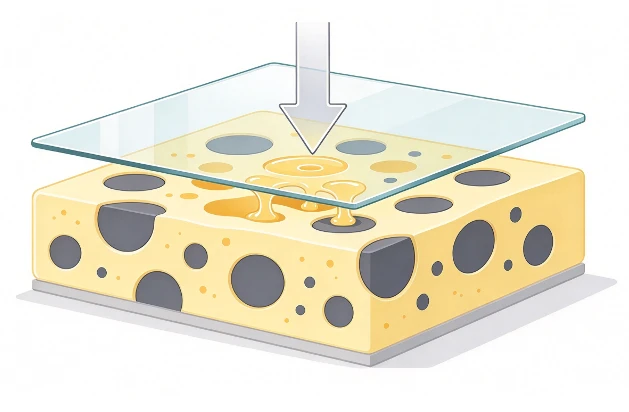
Under light pressure, the soft PVEE continuous phase deforms and wets the substrate, while tackifier-rich domains provide structural reinforcement. Schematic illustration. Actual results may vary.
But anyone who has tried coating a low-Tg polymer straight onto a release liner knows the failure mode. It wets beautifully. Then it creeps. Put a label on a curved bottle or pull a tape under tension, and the adhesive flows away, leaving residue. The low Tg that gives PVEE (CAS 25104-37-4) its tack is the same property that destroys its shear.
You have to resolve that tension in formulation. Usually, that means blending in a tackifier.
What a Tackifier Actually Does
A tackifier is not just "glue for glue." When you mix a compatible resin into PVEE, the film develops a two-phase microstructure. The tackifier-rich domains act as hard reinforcing zones that increase the effective modulus. The PVEE continuous phase stays soft, allowing the adhesive to wet out under light pressure.
Poly(vinyl ethyl ether) blends well with standard PSA resins. Rosin esters are the traditional choice and give aggressive quick-stick. Terpene phenolics improve cohesion and heat resistance. Aliphatic hydrocarbon resins work in co-solvent systems, especially when color stability matters. The resin class dictates the final balance, but the loading level dictates whether the film holds together.
Past work on vinyl ether adhesives points to a practical window: roughly 10–15 phr of tackifier. Below that, the film is underreinforced and creeps. Above it, the film gets too glassy and loses tack. It is a good place to start a ladder study. Just be aware that the optimum shifts depending on your coating thickness and substrate.
A25 vs. A50: Flow vs. Cohesion
The two PVEE grades you see most often are A25 and A50. They differ mainly in molecular weight. A25 has a K value of 10–17 (roughly 3,000–6,000 g/mol). A50 has a K value of 55–65 (roughly 70,000 g/mol). Both are low Tg. But they behave completely differently in a coating pan.
| Parameter | PVEE A25 Grade | PVEE A50 Grade |
|---|---|---|
| K Value | 10 – 17 | 55 – 65 |
| Approx. MW (g/mol) | 3,000 – 6,000 | ~70,000 |
| Physical State | Soft, flowing resin | Highly viscous syrup |
| Primary PSA Role | Wetting & Tack | Cohesion & Shear |
| Typical Application | Inks, coatings, heat-activated | Tapes, labels, structural bonding |
A25 acts like a soft resin. It wets out fast, flows under low pressure, and builds tack. It is what you want for adhesion promoters or heat-activated systems where getting the polymer to flow is the hard part. A50 acts like a polymer backbone. It resists creep. If you are making a tape or a label that has to hold under sustained load, you start with A50.
A lot of formulators blend them. A50 for structure, A25 for wetting. But be careful when switching grades. They are typically supplied as solutions in ethanol or another solvent, and the solids content is different. A formula developed at 50% solids with A25 will not just transfer over to A50. You have to rework the coating solids, drying schedule, and tackifier loading from scratch.
What to Look For on the COA
A datasheet gives you typical values. A Certificate of Analysis gives you what is actually in the drum. For Poly(vinyl ethyl ether) adhesive work, the difference matters.
A K value of 55 and a K value of 65 both pass as A50. But that is a significant swing in molecular weight. If you are running a tight coating line, a lower molecular weight batch might mean your shear holding power drops off. You want to see the actual measured K value, not just the spec range.
Volatiles are the other thing. Residual solvent or monomer affects film formation. If it is too high, the film can bubble or lose adhesion during the drying tunnel. And for clear tapes, color matters. PVEE is usually a pale yellow viscous liquid, but it can drift darker between batches. That does not change the adhesive properties, but it will show up in a transparent film. Alfa Chemical manufactures PVEE (CAS 25104-37-4) at our Zhengzhou facility and ships a batch-specific COA that lists the actual measured K value, volatiles, and color, so you can screen the lot before it hits the coater.
When evaluating the adhesive performance of your PVEE-based formulation, align your lab tests with standard PSTC methods: Loop Tack (PSTC-16), Peel Adhesion (PSTC-101), and Shear Holding Power (PSTC-107). Testing at standard 2 mil (50 µm) dry film thickness ensures your data remains comparable across different lots of resin.
When PVEE Is the Wrong Tool
PVEE makes sense when you need a hydrophobic, low-Tg backbone that can be tackified and applied without a lot of plasticizer. It works well in tapes, labels, and heat-activated systems. It is compatible with common tackifiers, which makes it easy to start experimenting.
It is not the right choice if you need high shear strength at 100°C without a reinforcing resin. It is also not the right choice for a water-based line, since PVEE is hydrophobic and does not disperse easily in water without a dedicated emulsification step. In those cases, acrylics or block copolymers will get you there faster. Choosing a polymer is less about finding the "best" one and more about matching its viscoelastic profile to the stresses it will see in service.
If you are setting up a ladder study, you can check the available grades and typical specs on thePVEE (CAS 25104-37-4) product page, or contact our technical team with details about your substrate and target peel strength. If PVEE is not the right fit, we will tell you.
References
1. Skeist, I. (Ed.). (1990). Handbook of Adhesives (3rd ed.). Springer. (Vinyl ether PSA formulation benchmarks).
2. Pressure Sensitive Tape Council (PSTC). Test Methods for Pressure Sensitive Adhesive Tapes.


