

PFOTES (CAS 51851-37-7): C6 Fluorosilane Coupling Agent Guide
Oct 12, 2026
A technical guide for formulators evaluating C6 fluorosilane coupling agents for hydrophobic and oleophobic coatings.
What Is PFOTES (CAS 51851-37-7)?
PFOTES (1H,1H,2H,2H-perfluorooctyltriethoxysilane, CAS 51851-37-7) is a C6 fluorosilane coupling agent used to create durable hydrophobic and oleophobic coatings on glass, silica, and metal oxide surfaces. It combines a perfluoroalkyl tail for low surface energy with a triethoxysilane head that bonds covalently to surface hydroxyl groups.
PFOTES is also known as perfluorooctyltriethoxysilane. It is a clear, colorless to light yellow liquid, with ≥97% purity by GC. The triethoxysilyl group hydrolyzes in the presence of moisture to form silanol groups, which then condense with surface hydroxyls to form Si-O-Si bonds. The perfluoroalkyl tail points outward and creates a low-surface-energy layer that repels both water and oil.
In short: PFOTES is a C6 fluorosilane coupling agent that bonds covalently to hydroxyl-bearing surfaces and provides durable hydrophobic and oleophobic performance.
How Does PFOTES Bond to a Surface?
PFOTES has two functional domains. The triethoxysilyl head (-Si(OEt)3) hydrolyzes in the presence of moisture to form silanol groups (-Si-OH). Those silanol groups then condense with hydroxyl groups on the substrate surface, forming covalent Si-O-Si bonds. The perfluoroalkyl tail (C6F13-CH2-CH2-) points outward and creates a low-surface-energy layer that repels both water and oil.
The covalent bond is what separates PFOTES from topical treatments. A temporary spray or wipe leaves a physisorbed layer that wears off. PFOTES forms a chemical bond that survives repeated wiping, solvent exposure, and moderate abrasion. That durability is why it is used in touch screens, optical lenses, and anti-corrosion coatings where performance must hold up over time.
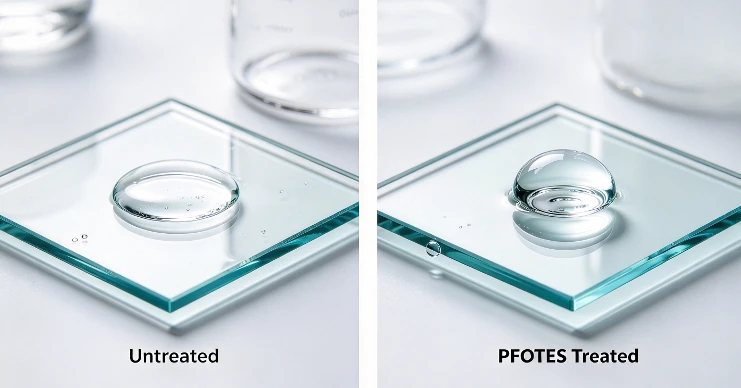
Water repellency comparison: untreated glass (left) vs PFOTES-treated glass (right)
Key point for formulators
PFOTES requires surface hydroxyls to bond. Substrates that lack surface -OH groups (polyolefins, untreated PET, pure copper) need a pre-treatment step such as plasma, UV-ozone, or a primer silane before PFOTES will anchor properly.
Why Choose C6 PFOTES Instead of C8?
C8 fluorosilanes offer the lowest surface energy available, but they are increasingly targeted by PFAS regulations. C6 fluorosilanes like PFOTES offer a practical middle ground: good hydrophobic and oleophobic performance with a shorter perfluoroalkyl chain that is under less regulatory pressure.
In short: PFOTES (C6) provides good hydrophobic and oleophobic performance with a cleaner regulatory profile than C8 fluorosilanes, at moderate cost.
| Parameter | C8 Fluorosilane | PFOTES (C6) |
|---|---|---|
| Surface energy | ~6 mN/m | ~10–12 mN/m |
| Water repellency | Excellent | Good |
| Oil repellency | Excellent | Good |
| Regulatory outlook | Restricted in several regions | Less pressure, still under review |
| Cost | Higher | Moderate |
For many industrial coatings, the small performance gap between C8 and C6 is an acceptable trade for a cleaner regulatory profile. PFOTES is not a drop-in replacement for every C8 application, but it covers most glass, ceramic, and metal oxide surface treatments.
Which Substrates Work Best with PFOTES?
PFOTES performs best on substrates with a high density of surface hydroxyl groups. The table below summarizes common substrates and what to expect.
In short: PFOTES bonds strongly to glass, silica, and metal oxides. Polyolefins, untreated PET, and pure copper require pre-treatment.
| Substrate | Bonding | Notes |
|---|---|---|
| Glass | Excellent | High surface silanol density; standard use case |
| Silica / Quartz | Excellent | Similar to glass; also used for nano-SiO2 |
| Metal oxides (Al2O3, TiO2) | Good to excellent | Depends on surface pre-treatment |
| Ceramic | Good | Glazed and unglazed behave differently |
| Aluminum (with oxide layer) | Good | Natural oxide provides -OH sites |
| Polyolefins / PET | Poor without pre-treatment | Plasma or UV-ozone required first |
| Pure copper | Poor | No stable surface oxide at room temperature |
How Should PFOTES Be Applied?
PFOTES is moisture-sensitive. The same moisture that drives hydrolysis during coating will also degrade the product in storage. Handling conditions matter as much as formulation.
In short: Dissolve PFOTES at 0.5–2% in ethanol or isopropanol, allow hydrolysis with trace moisture, apply to substrate, then cure at 100–120°C for 10–30 minutes.
Solvent
Ethanol, isopropanol, or ethanol/water mixtures. Fluorinated solvents are used when the substrate is sensitive to alcohol. Prepare solutions fresh and use within the working day.
Water Content
A small amount of water is needed for hydrolysis. Too much causes premature condensation and gelation. Weak acid (pH 4–5) can speed hydrolysis in some systems.
Concentration
Typically 0.5–2% by weight, depending on substrate and target contact angle. Higher concentrations can lead to thicker layers with diminishing hydrophobic returns.
Cure
Room temperature cure is possible, but heating to 100–120°C for 10–30 minutes improves condensation and coating durability. Adjust based on substrate thermal limits.
PFOTES Compared with Other Fluorosilanes
Fluorosilanes differ in the leaving group on the silicon atom. Chlorosilanes react fast but release HCl. Methoxysilanes release methanol. Ethoxysilanes like PFOTES release ethanol, which is the mildest byproduct and the easiest to handle in most industrial settings.
In short: Ethoxysilanes like PFOTES release ethanol during hydrolysis, which is the mildest byproduct compared with HCl from chlorosilanes and methanol from methoxysilanes.
| Type | Leaving Group | Handling |
|---|---|---|
| Chlorosilane | HCl | Corrosive; needs fume control |
| Methoxysilane | Methanol | Flammable byproduct; fast hydrolysis |
| Ethoxysilane (PFOTES) | Ethanol | Mild byproduct; moderate hydrolysis rate |
Regulatory Considerations for PFOTES
PFAS regulation is evolving. PFOTES is not on the most restrictive PFAS lists, but its status as a perfluoroalkyl-containing compound means it is under review in several jurisdictions. Buyers should confirm current status in their target markets before finalizing formulations.
What to check
- EU REACH status for the specific CAS and any derivatives
- EPA SNUR reporting requirements in the United States
- Canada SNAc notification status
- Country-specific PFAS restriction proposals
Summary: Is PFOTES Right for Your Coating?
PFOTES (CAS 51851-37-7) is a C6 fluorosilane coupling agent that forms covalent bonds with hydroxyl-bearing surfaces to create durable hydrophobic and oleophobic coatings. It is best suited for glass, silica, ceramic, and metal oxide substrates, and offers a cleaner regulatory profile than C8 fluorosilanes.
For formulators evaluating PFOTES, the key questions are: does your substrate have surface hydroxyls, is your process set up to handle moisture-sensitive silanes, and what is your target contact angle? Those three answers will tell you whether PFOTES is the right fit.
References:
1. Arkles, B. "Hydrophobicity, Hydrophilicity and Silane Surface Modification." Gelest, 2011.
2. Plueddemann, E. P. "Silane Coupling Agents." 2nd ed., Plenum Press, 1991.
You Might Also Like
-
CAS:98892-75-2 | 1-Butyl-2,3-Dimethylimidazolium Chloride
-

CAS:144163-97-3 | Thiazolylmethyl-4-nitrophenylcarbonate
-

CAS 3130-19-6 | BIS(3,4-EPOXYCYCLOHEXYLMETHYL) ADIPATE
-
![CAS:887919-36-0 | Bis[di-(tert-butyl)(4-trifluoromethylphenyl)phosphine]palladium(II) Chloride](/uploads/202235855/small/cas-887919-36-0-bis-di-tert-butyl-4a12268807940.jpg?size=384x0)
CAS:887919-36-0 | Bis[di-(tert-butyl)(4-trifluoromethylph...
-
CAS 31181-88-1 | 5-Fluoro-2-formylpyridine
-
![CAS:52066-63-4 | 4,4,8,8,12,12-Hexamethyl-8,12-dihydro-4H-benzo[1,9]quinolizino[3,4,5,6,7-defg]acridine](/uploads/202335855/small/490bd0b6-9309-45a8-a414-57ff561073de.jpg?size=384x0)
CAS:52066-63-4 | 4,4,8,8,12,12-Hexamethyl-8,12-dihydro-4H...