
Why Polythiol 504 Dominates High-Index Optical Resin Formulations
Oct 10, 2026
A formulator's guide to refractive index, Abbe number, NCO/SH ratio, and cure kinetics for high-index polythiourethane lenses
Polythiol 504 delivers a refractive index of 1.6300–1.6350 with an Abbe number of 34–36. Getting the most out of it requires more than just picking the right monomer - the NCO/SH ratio, water content, and cure cycle all determine whether the final lens is clear or hazy, thin or thick, durable or brittle.
This guide covers: molecular structure, key specifications, the refractive index vs Abbe trade-off, NCO/SH formulation range, cure kinetics, and quality parameters to check on every batch.
Introduction
A patient walks into an optician with a -8.00 prescription. Standard CR-39 lenses in that prescription would be roughly 8 mm thick at the edge. A 1.60-index lens cuts that to about 5 mm. The difference matters to the patient. It also matters to the formulator choosing a monomer
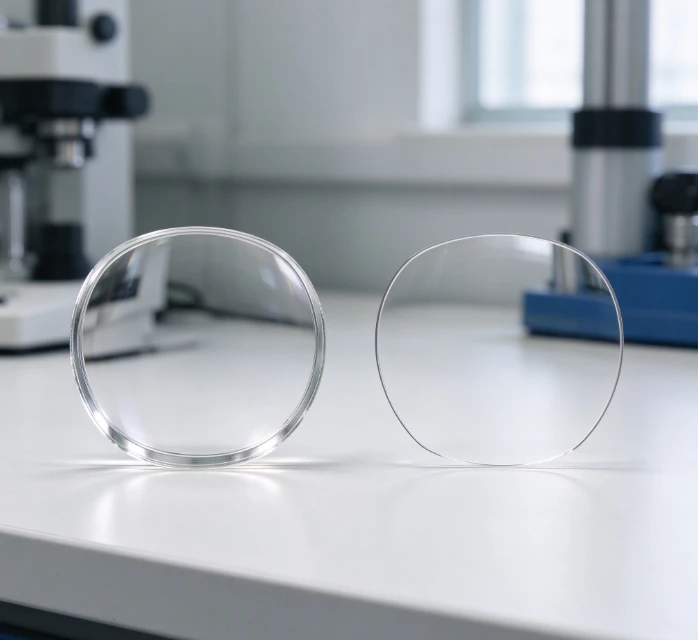
A 1.60-index lens using Polythiol 504 cuts edge thickness by roughly 40% compared to standard CR-39. Schematic illustration.
Refractive index is the headline number for high-index lenses. But it is not the only one. Abbe number, which measures chromatic dispersion, determines whether the patient sees color fringing at the edges of the lens. Water content in the monomer determines whether the cured lens has bubbles. NCO/SH molar ratio determines whether the resin cures completely or stays soft.
Polythiol 504 (CAS 131538-00-6), also known as 4-(mercaptomethyl)-3,6-dithia-1,8-octanedithiol, sits at the center of this balancing act. This article covers the chemistry, the data, and the formulation parameters that matter when using it in polythiourethane lens systems.
What Makes Polythiol 504 Different

Three thiol groups on a C7 backbone, with five sulfur atoms driving the refractive index.
Five sulfur atoms in a compact C7 frame
The molecule is built on a propane backbone. Three thiol (-SH) groups hang off it - one directly on the first carbon, two connected via ethylthio linkages that each carry a terminal thiol. Five sulfur atoms sit in a compact C7 frame.
That sulfur density is what drives the refractive index. Light slows down when it passes through a medium with more polarizable electrons. Sulfur has more electrons than oxygen or carbon, and sulfur-sulfur bonds are more polarizable than carbon-carbon bonds. Pack five sulfur atoms into a molecule with a molecular weight of only 260.53 g/mol, and the refractive index climbs to 1.6300–1.6350 at 20°C.
Trifunctional architecture builds crosslinked networks
The three thiol groups make it trifunctional. During curing, each thiol reacts with an isocyanate (-NCO) group to form a thiourethane bond (-NH-CO-S-). Three thiols per molecule means three connection points, which builds a three-dimensional crosslinked network. Higher crosslink density gives the cured resin better mechanical strength and thermal stability than a difunctional thiol could achieve.
Flexible spacers improve impact resistance
The ethylthio linkages between the thiol groups introduce flexibility into the backbone. A purely rigid polythiourethane network would be brittle. The short -(CH2)2-S- spacers allow some energy absorption without sacrificing the high refractive index that the sulfur atoms provide.
Key Specifications for Formulators
Reference data at a glance
When selecting Polythiol 504 for a lens formulation, these are the numbers that matter:
| Item | Value |
|---|---|
| CAS Number | 131538-00-6 |
| Molecular Formula | C7H16S5 |
| Molecular Weight | 260.53 g/mol |
| Purity | ≥ 99% |
| Thiol Content | 36 – 38% (w/w) |
| Refractive Index | 1.6300 – 1.6350 (20°C, nD) |
| Abbe Number | 34 – 36 (for 1.60 index resin) |
| Water Content | ≤ 500 ppm |
| APHA Color | ≤ 8 |
| Density | 1.214 g/cm³ |
| Appearance | Colorless to pale yellow liquid |
Why water content is the hidden variable
Water content of ≤ 500 ppm is critical. Isocyanates react with water to form carbon dioxide, which creates bubbles in the cured lens. Keeping water below 500 ppm prevents this side reaction from becoming visible in the final product. The refractive index of 1.6300–1.6350 applies to the raw monomer. Once reacted with a diisocyanate, the cured polythiourethane network will have a refractive index determined by the full blend, typically in the 1.59–1.67 range.
The Refractive Index vs Abbe Number Trade-off
Why higher index usually means more color fringing
There is a general rule in optical materials: as refractive index increases, Abbe number decreases. Higher index usually means higher dispersion, which means more color fringing.
Polythiol 504 challenges that rule because of its molecular structure. The sulfur atoms raise the refractive index, but the ethylthio linkages introduce electron delocalization that moderates dispersion. In a 1.60-index lens system, formulations using Polythiol 504 achieve an Abbe number of 34–36.
How it compares to other lens materials
For context, a standard 1.50-index CR-39 lens has an Abbe number of about 58. A 1.67-index MR-7 lens has an Abbe number of about 32. Polythiol 504 in a 1.60 system sits in the middle - significantly higher index than CR-39 with acceptable chromatic performance.
Why Abbe number is formulation-specific
Abbe number is a property of the cured resin, not the raw monomer. It depends on the full monomer blend and the isocyanate choice. This is why suppliers who publish a standalone Abbe number for a polythiol are misleading. The correct approach is to ask for Abbe number data at a specific formulation.
NCO/SH Molar Ratio: The Formulation Variable That Matters Most
Working range: 0.8 to 1.2
The NCO/SH molar ratio - isocyanate groups to thiol groups - determines whether the network fully cures. For polythiourethane lens systems, the typical working range is 0.8 to 1.2. At 1.0, stoichiometric balance, every NCO finds an SH and vice versa. In practice, a slight excess of one component is often used to compensate for side reactions or to adjust the final properties.
What happens outside the range
Below 0.8, unreacted thiol groups remain in the resin, which can cause odor and reduce crosslink density. Above 1.2, unreacted isocyanate can react with moisture over time, causing yellowing or haze.
A published formulation example
A formulation example from a Chinese patent illustrates the practical approach. The composition includes 40 g of Polythiol 504, 15 g of isophthalic dimethyl isocyanate, 35 g of isophorone diisocyanate, and 7.5 g of pentaerythritol tetraacrylate as a co-monomer. The resulting optical material achieved a refractive index of 1.662–1.693 depending on the specific formulation variant, with visible light transmittance above 90%.
Note the use of two different isocyanates. Isophthalic dimethyl isocyanate contributes rigidity and refractive index. Isophorone diisocyanate, being aliphatic, contributes weather resistance and impact strength. Blending isocyanates is a common technique to balance multiple properties in one resin.
Curing Kinetics and Catalyst Selection
First-order kinetics with XDI
A published study on the cure kinetics of Polythiol 504 with m-xylylene diisocyanate (XDI) used triethylamine as a catalyst and measured the reaction by FTIR at 75°C–105°C. The reaction follows first-order kinetics with respect to isocyanate concentration. The activation energy is 100.23 kJ/mol. Higher catalyst content shortens gel time. The negative entropy of activation suggests a rigid transition state during the rate-determining step.
Practical implications for production
In practical terms, this means three things. First, the cure rate is predictable and can be modeled, which helps with cycle time planning. Second, increasing catalyst concentration has a linear effect on gel time, so catalyst loading is a simple dial for adjusting cure speed. Third, the 75°C–105°C range is where the reaction proceeds at production-relevant speeds. Below 75°C, the cure becomes impractically slow without higher catalyst loading.
Applications Beyond Eyeglass Lenses
Automotive glazing
High-index polythiourethane can be cast into lightweight, impact-resistant window panels. The refractive index is less critical here than the impact strength and optical clarity, but the same monomer serves both purposes.
UV-curing coatings and adhesives
The thiol groups participate in thiol-ene reactions under UV light, forming crosslinked networks at room temperature. This enables coatings on heat-sensitive substrates where thermal curing is not possible.
Epoxy curing agents
Thiol-epoxy systems cure faster at lower temperatures than amine-epoxy systems. Polythiol 504 provides three reactive sites per molecule, enabling high crosslink density at room temperature.
Heavy metal capture
Thiol groups chelate heavy metal ions. Polythiol 504 is used in waste water treatment and metal recovery applications.
Quality Parameters and Batch Consistency
Why batch consistency matters more than peak purity
For optical applications, batch-to-batch consistency matters as much as absolute purity. A change in thiol content from 37% to 36% shifts the stoichiometric balance and can throw off the NCO/SH ratio in a formulation that was optimized for one batch.
Four COA parameters to verify on every batch
Thiol content by titration - determines the equivalent weight for stoichiometric calculations.
Refractive index at 20°C - measured on the raw monomer.
Water content by Karl Fischer titration - prevents CO₂ bubble formation during curing.
APHA color - indicates the presence of oxidation products or impurities that can affect the final lens color.
Alfa Chemical supplies Polythiol 504 from our Zhengzhou, China facility with batch-specific COA reporting measured values for all of these parameters. For formulation support or a sample COA, reach us through our Contact Us page. For related optical monomers and polythiols, see our organic building blocks range.
Summary
What formulators need to remember
Polythiol 504 delivers a refractive index of 1.6300–1.6350 in the raw monomer and an Abbe number of 34–36 in 1.60-index lens systems. The trifunctional structure builds crosslinked polythiourethane networks with good mechanical properties. The NCO/SH ratio should be kept in the 0.8–1.2 range for complete cure. Water content below 500 ppm prevents bubble formation. Cure kinetics are first-order, with an activation energy of 100.23 kJ/mol.
The data in this article comes from published literature and supplier specifications. Formulators should verify batch-specific values against a COA and conduct their own suitability testing under actual production conditions.
For Polythiol 504 specifications, COA, or a research sample, see the product page or contact our technical team.
This article is for technical reference only. Product specifications are for reference purposes. Users should conduct their own suitability tests under actual conditions. This product is for industrial manufacturing and R&D use only. Not for food, pharmaceutical, or cosmetic applications without specific regulatory compliance testing.