

Poly(vinyl ethyl ether) CAS 25104-37-4: Replacing Lutonal A25/A50, Reading the Spec, and Checking Each Incoming Lot
Nov 24, 2026
A sourcing and incoming-QC reference for poly(vinyl ethyl ether) (PVE/PVEE, CAS 25104-37-4): how the A25 and A50 grades compare, what parameters belong on the inquiry or COA, how to screen the drum on receipt, and what to record for storage and second-source qualification.
⚡ Core insight: A PVE/PVEE grade swap cannot be judged by the trade name alone. Map the replacement by K value and molecular weight, confirm whether the drum is neat resin or an ethanol solution, and check the batch COA before the lot goes into coating or adhesive production. Chemistry, grades and applications are covered in our separate guides; this article stays on sourcing and incoming QC.
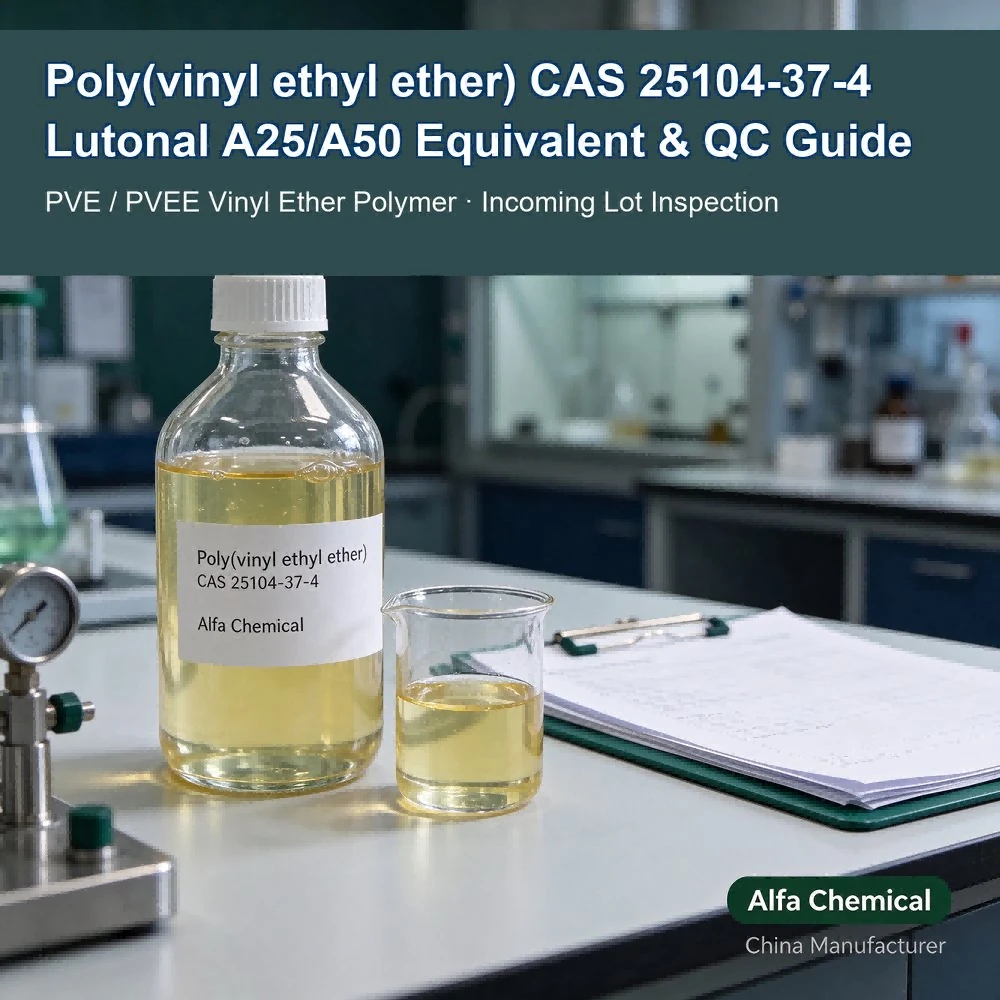
Poly(vinyl ethyl ether), written PVE or PVEE (CAS 25104-37-4), is a low-Tg vinyl ether homopolymer supplied in two common grades, A25 and A50, used as a plasticizing soft resin or as a cohesive adhesive resin. When you source it as a Lutonal A25/A50 equivalent, the decision is not a brand-name swap alone: you match the grade by K value and molecular weight, confirm the solids basis, and review the batch COA before release. The chemistry and main applications are outlined in the PVE vs PVEE guide; PSA tackifier balance and test methods are in the PVEE in pressure-sensitive adhesives article.
What Buyers and Formulators Look Up
Search interest for this product usually splits into three groups, each asking a different question before purchasing:
- Identification and equivalence: "What is poly(vinyl ethyl ether) CAS 25104-37-4?", "PVE vs PVEE", "Lutonal A25/A50 equivalent", "polyvinyl ether resin". The goal is to confirm product identity and whether the material matches the brand-grade already in use.
- Grade and selection: "A25 vs A50 K value", "which grade for adhesive or coating", "molecular weight 3000 vs 70000", "ethanol solution solids content". The question is which grade and which physical form fit the existing formulation.
- Sourcing, documentation and acceptance: "manufacturer or supplier China", "COA SDS", "specification parameters", "storage and handling", "lot-to-lot consistency". These buyers are qualifying a source and preparing incoming inspection.
The sections below follow that order: grade mapping, the specification to request, document and incoming inspection, storage and handling, and a short second-source checklist.
Matching a Lutonal Equivalent by K Value and Molecular Weight
When a formulation is converted from BASF Lutonal A25 or A50 to a locally supplied PVE/PVEE, the safest starting point is the polymer's molecular-weight marker rather than the trade name. The two Alfa grades line up as follows:
K value and molecular-weight bands are catalogue ranges for the two grades; the shipped lot's measured K value and solution basis are reported on the COA.
Two equivalence checks matter before you treat the swap as direct:
- Match the solids basis. Some grades are supplied as neat resin; others are sold as a solution in ethanol (for example a 50% ethanol carrier). A formula balanced on a neat A25 will not transfer one-to-one to a solution grade unless the solvent and solids are rebalanced. Ask whether the quotation is resin-on-resin or solution, and at what solids percentage.
- Match the service condition, not just the grade label. Both grades share a glass transition around −60 °C, but A25 wets and flows while A50 resists creep. If the original formulation held under load at temperature, confirm the A50 chain length and tackifier balance rather than assuming the low Tg alone will hold the bond.
Historical Lutonal application notes for nitrocellulose lacquers, resin paints and packaging inks are summarized in the poly vinyl ether (Lutonal) application overview.
Specifications to Put on the Inquiry or Contract
A generic "PVE resin" specification leaves too much room for lot variation. For an inquiry or purchase order, request the parameters that actually drive formulation behavior. Reference ranges below are catalogue values; the accepted lot is judged against the batch COA.
Physical figures are typical catalogue ranges; the shipped lot's appearance, viscosity, measured K value and volatiles are reported on the COA.
Full catalogue values and packaging are listed on the PVE/PVEE CAS 25104-37-4 product page.
Incoming Inspection Before Release
Before a drum is released to production, a lightweight QA sequence catches most source-mix-up and documentation problems. These are screening checks; they do not replace formulation or adhesive performance testing on the qualified lot.
- Match the paperwork to the drum. Check that the PO, packing list, COA and drum label agree on product name, CAS 25104-37-4, grade (A25/A50), batch/lot number, and net weight. A label that cannot be traced to a COA should be held, not issued to production.
- Read the COA measured values. Look for the reported K value, solids or solution basis, appearance/color, density, pH and loss on drying. A K value at either edge of the A50 range can shift cohesion; confirm it still meets your internal specification before approval.
- Do the visual and odor screen. The resin should be a clear, viscous liquid without separated layers, gel, sediment, or visible contamination. Note color on the lot record. Off odor or an unexpected solvent note should trigger a hold and recheck against the SDS.
- Check packaging and seals. Drums should be intact, sealed, and labeled with lot and hazard information. Damaged, leaking, or unlabeled packaging is rejected or held pending review; keep opened drums resealed and upright.
If the lot is a first shipment from a new source, retain a sample and record the measured parameters so later batches can be compared against the approved baseline.
Storage, Handling and Safety
Poly(vinyl ethyl ether) itself is stable under recommended storage, but the commonly supplied ethanol solution carries the solvent's hazard profile. The points below are general handling guidance; always follow the batch SDS and the site's chemical storage rules.
- Keep containers closed and in a cool, dry, ventilated place, away from direct heat, ignition sources and strong oxidizers. Reseal opened drums promptly and store upright to prevent leakage.
- Respect the ethanol solution flammability signal. The 50% ethanol solution SDS carries a flammable-liquid-and-vapour signal and eye/respiratory irritation notes; ground and ventilate where solvents are handled, and keep ignition sources out of the work area.
- Use standard PPE: gloves and eye protection, and ventilation where vapour or mist may be generated. Refer to the SDS for exposure controls and first-aid measures; flash point and classification are stated on that batch SDS, not assumed from this article.
- Segregate and label. Store away from incompatible materials, keep lot identification with the container, and do not decant into unlabeled secondary containers.
Qualifying a Second Source, Lot by Lot
When a backup manufacturer is being qualified, compare the same reported parameters across several lots rather than judging from a single sample:
- Grade and K value, and the resulting molecular-weight band, against your current approved source.
- Solids basis and carrier solvent, so dosing and drying can be matched without reworking the formula.
- Viscosity at the reported solids and temperature, color, and loss on drying.
- Documentation format: COA parameters, SDS, packaging options (20 kg / 170 kg drums) and sample availability for laboratory evaluation.
Run a small trial at your standard film thickness and service condition, and keep retained samples from each approved lot for traceability. For specification alignment, samples or bulk terms, contact our technical team with the parameters and format from your current COA.
Frequently Asked Questions
Q. Is PVE the same chemical as PVEE?
Yes. Both abbreviations refer to poly(vinyl ethyl ether), CAS 25104-37-4. "PVE" is also used loosely for the broader poly(vinyl ether) family; PVEE is the more precise shorthand for this ethyl-side-chain polymer. The identification and naming are explained in the PVE vs PVEE guide.
Q. Can I replace Lutonal A25 or A50 directly with an Alfa grade?
The grades are set up as performance equivalents by K value and molecular weight: A25 for soft-resin and leveling roles, A50 for cohesive adhesive and rubber roles. Confirm the solids basis (neat versus ethanol solution) and run a small trial at your standard thickness and service condition before full conversion.
Q. Is poly(vinyl ethyl ether) water-based?
No. It is hydrophobic and does not disperse readily in water without a dedicated emulsification step. It is supplied in solvent systems such as ethanol, and it dissolves in alcohols, esters, ketones and chlorinated solvents. If your line is water-based, check compatibility before specifying this resin.
Q. What should the COA show for an incoming lot?
At minimum the batch COA should state grade, measured K value, solids or solution basis, appearance/color, density, pH and loss on drying, with the lot number matching the drum label. Compare those measured values against your internal specification before release.
Q. What packaging and sample sizes are available?
Standard packaging is 20 kg and 170 kg drums; laboratory samples are available on request for evaluation. Stock lead time and current sample or bulk terms are confirmed with the sales team for each order.
Manufacturing & Supply Note
Alfa Chemical is a manufacturer and supplier of organic, material-science and life-science chemicals, based in Zhengzhou, Henan, China. We support projects from laboratory-scale screening through commercial production and bulk supply.
Within our material-science range, PVE/PVEE (CAS 25104-37-4) is supplied with batch-specific COA and SDS on request. For formulation and grade-selection background, see our articles on polymer identity and grades and PSA adhesive behavior. To request qualification data or a sample, contact our technical team.
Cite this article:
Alfa Chemical Technical Team. "Poly(vinyl ethyl ether) CAS 25104-37-4: Replacing Lutonal A25/A50, Reading the Spec, and Checking Each Incoming Lot." Alfa Chemical Technical Articles, November 2026.
Web. URL: https://www.alfa-chemical.com/info/poly-vinyl-ethyl-25104-37-4-lutonal-equivalent-103752888.html
Disclaimer: This article is for industrial and laboratory reference only. Not for human or animal consumption. The property values and grade ranges described here are typical catalogue values, not guaranteed batch values; batch-specific analytical data is provided on the Certificate of Analysis. Regulatory status is given for reference only, and buyers must verify destination-market compliance for their specific end use. Lutonal® is a registered trademark of BASF SE; Alfa Chemical is an independent manufacturer and supplier of performance-equivalent products.
Related Reading
- PVE/PVEE (CAS 25104-37-4) product specification - grades, K value, packaging and batch documentation.
- PVE vs PVEE: a technical guide to this vinyl ether polymer - identity, A25/A50 profile and main applications.
- PVEE in pressure-sensitive adhesives: why low Tg is not enough - tackifier balance, cohesion and lot COA review for tapes and labels.
You Might Also Like
-

CAS 2937-81-7 | 2,5-DIAMINO-1,3,4-THIADIAZOLE
-
CAS:80722-63-0 | 1,3-bis-(3-Methacryloxypropyl)tetrakis(t...
-

CAS:112811-66-2 | 2,4,5-Trifluoro-3-methoxybenzoyl Chloride
-

CAS:902837-42-7 | 7-Bromo-1H-pyrrolo[3,2-c]pyridine
-

CAS:15554-47-9 | Tris(acetylacetonato)yttrium
-
CAS:75714-59-9 | (R)-3,3'-Dibromo-2,2'-dimethoxy-1,1'-bin...