
HDI Trimer's Isocyanurate Ring: Why It Builds Tougher Polyurethane Networks
Oct 20, 2026
HDI trimer (CAS 28182-81-2), is not simply a three-functional version of hexamethylene diisocyanate. The trimerization reaction that forms it creates a six-membered isocyanurate ring - a structure that fundamentally changes how the crosslinker behaves in a polyurethane network. For formulators working with high-performance coatings and adhesives, understanding that ring is the difference between using HDI trimer as a commodity hardener and using it as a precision tool for network design.
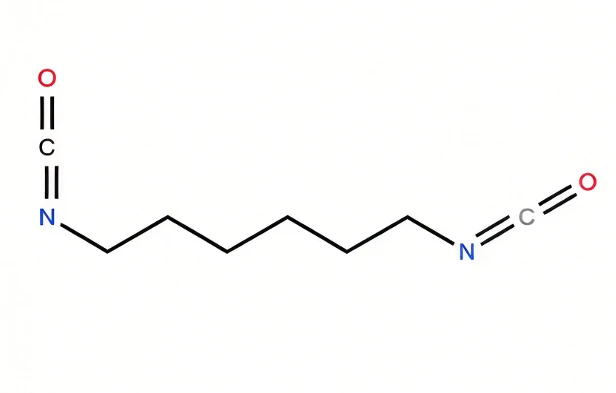
The isocyanurate ring creates a compact, thermally stable core with three terminal NCO groups.
Three HDI monomer units cyclize into this ring, each retaining a terminal isocyanate group. The result is a molecule with a rigid, planar core and three reactive arms. Compared with HDI biuret - the other common aliphatic polyisocyanate - the isocyanurate ring packs the NCO groups more tightly and introduces less flexible linkage into the crosslinked network. That structural difference is the root of nearly every performance contrast between the two hardeners.
Trimer vs. Biuret vs. IPDI: Choosing the Right Network Topology
Selecting an aliphatic hardener for polyurethane systems often starts with comparing HDI trimer (CAS 28182-81-2) against HDI biuret and IPDI trimer. Each crosslinker dictates a different network topology, which in turn dictates the final film properties.
| Parameter | HDI Trimer (Isocyanurate) | HDI Biuret | IPDI Trimer |
|---|---|---|---|
| Core Structure | 6-membered rigid ring | Flexible linear linkage | Cycloaliphatic ring |
| Viscosity (25°C) | Medium (2,500 mPa·s) | Higher than trimer | Low (700–1,000 mPa·s) |
| Hardness / Flexibility | Balanced, tough | More flexible | Harder, brittle |
| Cure Speed | Fast | Fast | Slow |
| Best For | Auto clearcoat, industrial topcoat | Flexible coatings, sealants | High-hardness, low-VOC systems |
If the formulation demands high impact resistance alongside weatherability, HDI biuret is often the more flexible option. However, biuret introduces linear linkages that can be more susceptible to thermal degradation. IPDI trimer, on the other hand, uses a cycloaliphatic structure. It yields significantly harder films and lower viscosity, but the secondary hydroxyl groups formed during cure react much slower, making it less ideal for ambient-cure systems.
HDI trimer lands in the middle, but it wins on durability. The rigid isocyanurate ring resists thermal breakdown far better than linear linkages. In accelerated weathering tests, HDI isocyanurate networks consistently outperform biuret networks in gloss retention because the ring structure is less prone to UV-induced chain scission.
Why the Ring Lowers Viscosity Without Diluting Crosslink Density
One of the less obvious consequences of the isocyanurate ring is its effect on viscosity. The standard HDI trimer (CAS 28182-81-2) at roughly 21.8% NCO content sits around 2,500 mPa·s at 25°C. The ring does not act as a diluent; it is part of the network. But its compact geometry reduces the entanglements and intermolecular friction that would otherwise push viscosity up.
For a formulator, this is a quiet but significant advantage. Lower crosslinker viscosity means less solvent is needed to reach a sprayable application viscosity. In high-solids systems, that translates directly into lower VOC without sacrificing the crosslink density that drives chemical resistance and mechanical strength.
The Aromatic Question: Why Aliphatic Is Non-Negotiable
Unlike MDI or TDI-based hardeners, the aliphatic isocyanurate ring has no conjugated double bonds to absorb UV radiation and trigger yellowing. The difference lies in the degradation pathway. Aromatic polyurethanes form quinone-imide structures upon UV exposure, which appear as a deep yellow or brown discoloration. Aliphatic networks, anchored by the HDI isocyanurate ring, lack this pathway.
For exterior clearcoats, that is non-negotiable. Even in applications where color is less critical, the absence of aromatic degradation pathways extends the service life of the film, preventing the chalking and embrittlement that typically follow UV exposure in aromatic systems.
NCO:OH Ratio and the Index Window
With an NCO content of 21.8 ± 0.3%, HDI trimer has an equivalent weight of roughly 193 g/eq. That number sets the stoichiometry. In a standard 2K polyurethane clearcoat, formulators run an NCO:OH index of 1.05–1.15 - slightly above stoichiometric to compensate for ambient moisture and to drive the reaction toward completion.
The index window matters more with HDI trimer than with some other crosslinkers because the isocyanurate ring's rigidity amplifies the effect of under- or over-indexing. Running too low leaves unreacted hydroxyl groups that plasticize the film. Running too high introduces excess NCO groups that can react with moisture to form urea linkages, causing brittleness and surface defects.
The REACH 0.1% Threshold: Why Monomer Content Is a Formulation Variable
Free HDI monomer is a respiratory sensitizer. When formulating with HDI trimer (CAS 28182-81-2), it is critical to monitor residual monomer levels. Under REACH Annex XVII Entry 74, products containing more than 0.1% by weight of diisocyanate monomers may only be used if the user has completed specific safe-handling training. Below that threshold, the training obligation does not apply.
Alfa Chemical manufactures HDI trimer to ≤0.20% free monomer, well below the 0.5% industry definition of a "low-monomer" grade. For formulators supplying into EU industrial settings where the 0.1% threshold is a hard compliance line, the specification matters. Ultralow-monomer grades below 0.1% are available. The trade-off is a slight increase in viscosity and cost, because stripping monomer to that level requires more intensive thin-film evaporation.
What the COA Tells You That a Datasheet Cannot
A datasheet reports typical values. A batch-specific COA reports what is actually in the drum. For HDI trimer (CAS 28182-81-2), three parameters on the COA drive the formulation more than any others: NCO content, free monomer, and color.
NCO content directly sets the equivalent weight. A shift from 21.8% to 21.5% changes the equivalent weight by roughly 3 g/eq, which is enough to throw off a tight NCO:OH index. Color, reported as Hazen or APHA, matters for water-white clearcoats: a batch at Hazen 30 and a batch at Hazen 60 may both be "within spec," but only the lower-color batch will keep a premium clearcoat from drifting toward a straw tint.
Alfa Chemical manufactures HDI trimer at our Zhengzhou facility using catalytic trimerization followed by thin-film evaporation. Every drum ships with a batch-specific COA reporting actual NCO, viscosity, monomer content, and Hazen color. For formulators setting up a new system or switching suppliers, the HDI Trimer (CAS 28182-81-2) product page lists the full specification envelope, and our technical team can help match the grade to the application's monomer and viscosity requirements.
Ultimately, the isocyanurate ring in HDI trimer (CAS 28182-81-2) provides a structural advantage that linear crosslinkers cannot match. When designing for long-term weatherability and thermal stability, the trimer's rigid core dictates the balance between crosslink density and flexibility. Before scaling up, it is worth running a ladder study to lock in the NCO:OH index and reviewing actual free monomer levels against your regional compliance targets. For formulators evaluating this chemistry, Alfa Chemical provides baseline specifications and batch-specific COA data from our Zhengzhou, China facility to support your initial trials. Refer to the HDI Trimer (CAS 28182-81-2) technical page for current grade availability.