

Beyond TBAB: Overcoming the Emulsion Trap in Cetylpyridinium Chloride Phase Transfer Catalysis
Nov 06, 2026
Why your phase transfer catalyst is degrading under high-pH conditions, and the downstream workup strategies required when switching to pyridinium-based salts.
In this technical note:
1. The Real Reason to Abandon TBAB: Aromatic Stability
In many biphasic nucleophilic substitutions, tetrabutylammonium bromide (TBAB) is the default choice. It works well-until you introduce strong bases (such as 50% NaOH) and temperatures above 60°C. Under these conditions, the aliphatic chains of TBAB undergo Hofmann elimination (degrading into tributylamine and butene). Once degraded, the catalyst is dead, and the generated tributylamine becomes a stubborn organic impurity that alters pH and complicates purification.
Cetylpyridinium Chloride (CPC, CAS 123-03-5) solves this specific chemical bottleneck. Unlike TBAB, CPC features a pyridinium ring. The aromaticity provides immense resonance stability, making the cation virtually immune to Hofmann elimination. You can run your biphasic reaction at high pH and 80°C, and the CPC catalyst will remain structurally intact, maintaining consistent phase-transfer kinetics from start to finish.
showing the degradation of an aliphatic chain via Hofmann elimination versus the resonance-stabilized pyridinium ring of CPC.
2. The CPC Trade-off: High Reactivity vs. Stubborn Emulsions
While CPC provides superior alkaline stability, it comes with a well-known operational challenge: it is a highly active cationic surfactant. The 16-carbon cetyl chain is what makes it such an effective phase transfer agent, but that same lipophilic tail aggressively anchors at the aqueous-organic interface.
When you finish your reaction and stop stirring, the phases may not separate cleanly. You will often see a thick, milky rag layer-a stubborn macro-emulsion-trapping your desired product. In severe cases, this emulsion can take hours to separate, killing your productivity and causing yield loss.
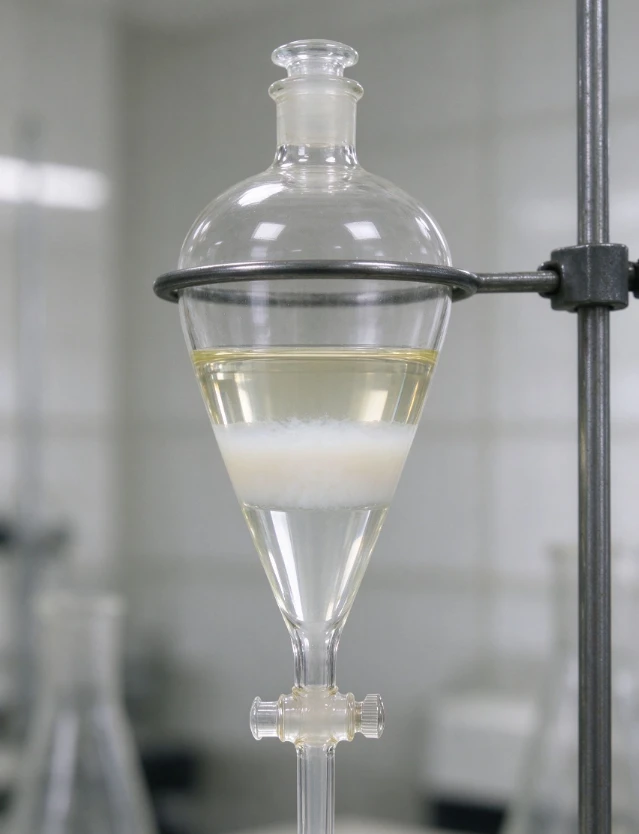
A thick macro-emulsion (rag layer) formed between the organic and aqueous phases. This is a common downstream workup challenge when using highly surface-active catalysts like CPC. Actual results may vary depending on the solvent system.
3. Demulsification Strategies for Downstream Workup
If you switch from TBAB to CPC, your downstream workup needs a slight adjustment. Do not wait until post-extraction to deal with the emulsion. Here are three proven strategies to break it:
- Add an Inorganic Salt (Salting-Out Effect): Adding 5–10% w/v of sodium chloride (NaCl) or sodium sulfate (Na2SO4) to the aqueous phase before separation increases the ionic strength. This forces the CAS 123-03-5 catalyst into the organic phase and destabilizes the emulsion.
- Gently Raise the Temperature: CPC emulsions are highly temperature-sensitive. Slightly warming the mixture (to 40–50°C) can quickly break the interfacial tension and clarify the phase boundary.
- Use a Co-Solvent: A small amount of a polar aprotic solvent (like a few percent of isopropanol or ethanol) added at the end of the reaction breaks the interfacial film and allows the layers to drop cleanly.
4. Purity Metrics That Dictate Catalytic Efficiency
In phase transfer catalysis, CPC acts as a stoichiometric carrier. Therefore, any inactive impurity acts as dead weight. Residual free amine (unquaternized cetylpyridine) is particularly detrimental, as it consumes the reactive anion you are trying to transfer and alters the pH of the aqueous phase.
When sourcing CPC for catalysis, you must demand the actual analytical data. Look for a Purity (Assay on dried basis) of ≥ 99.0% by HPLC, a Loss on Drying (LOD) ≤ 0.5% (to avoid caking and water interference in non-aqueous phases), and Heavy Metals ≤ 20 ppm.
Alfa Chemical manufactures this industrial-grade CPC at our Zhengzhou facility. We provide the actual HPLC chromatograms and water content data for every batch, ensuring that the catalyst you validate at the bench will perform identically when you scale up your biphasic production.
Struggling with catalyst degradation or emulsion separation in your process?
Talk to Our Technical Team →Share this article:
Alfa Chemical R&D Team. (2026). Beyond TBAB: Overcoming the Emulsion Trap in Cetylpyridinium Chloride Phase Transfer Catalysis. Alfa Chemical Technical Library.
Disclaimer: For industrial and laboratory research use only. Not for human or animal consumption. The workup strategies provided are for general reference. Actual demulsification conditions depend on your specific solvent system. Buyers are responsible for verifying regulatory compliance and ensuring safe handling according to the product SDS.


