

Why Your F-44 Epoxy Tg Falls Short: The EEW Drift Problem and DDS Stoichiometry
Nov 05, 2026
The gap between the catalogue EEW and your actual lot shifts crosslink density. Here is how to adjust your DDS phr and verify hydrolyzable chlorine before the batch fails.
You just pulled the DMA results. Tg came back at 185°C. Your target was 210°C. The curing cycle was identical. The oven is calibrated. The vacuum bagging was tight.
The problem is not your process. It is the specific drum of F-44 phenolic epoxy resin (CAS 9003-36-5) you just opened. The Epoxy Equivalent Weight (EEW) drifted toward the top of the specification. The formulation team at Alfa Chemical (Zhengzhou, China) sees this failure mode repeatedly when formulators calculate stoichiometry against a catalogue midpoint instead of the actual lot COA.
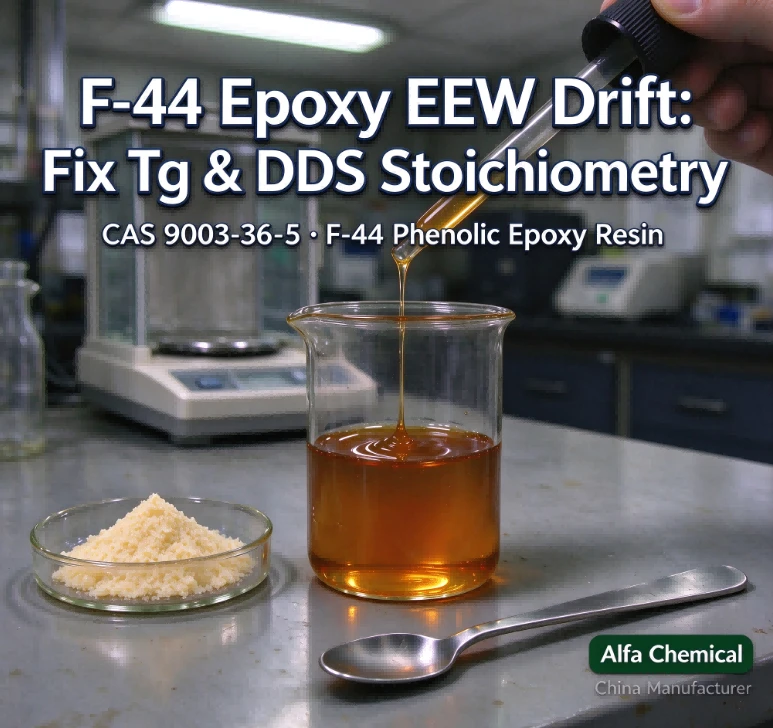
Figure 1: Lot-to-lot EEW variance directly impacts DDS stoichiometry and the final crosslink density of the cured network.
The Chemistry of EEW Drift
F-44 is a phenol-formaldehyde epichlorohydrin polycondensate. It is an oligomer distribution, not a single molecule. Average functionality sits at 2.5–2.8.
A datasheet listing "EEW 160–180" hides the variance. An EEW 180 lot has fewer reactive epoxy groups per gram than an EEW 160 lot. If you formulate using the 170 midpoint to calculate DDS (diaminodiphenyl sulfone) hardener, you will over-charge a 180 lot.
Excess amine acts as a chain terminator. The network stops growing early. Crosslink density drops. Tg collapses.
Formulation Trap: Calculating DDS phr from the 170 midpoint instead of the actual lot EEW can shift your cured Tg by 15–20°C. Hydrolyzable chlorine above 500 ppm also poisons the kinetics, accelerating gelation before the resin flows.
Data Verification: DDS Consumption vs. EEW
To reach Tg 200–220°C with a staged post-cure (120°C/2h + 177°C/2h + 200°C/2h), stoichiometry must be exact. Here is the DDS phr shift based on lot EEW (DDS AHEW = 62):
Eliminating the Variable: Lot-Specific Control
Formulators cannot target a moving number. Calculate your stoichiometry against the drum in front of you.
Alfa Chemical produces F-44 phenolic epoxy resin (CAS 9003-36-5) at our facility in Zhengzhou, China. We reject the range-only approach. Every drum is titrated, and the COA reports the single measured EEW for that specific batch.
We also control the washing stages in-house to keep hydrolyzable chlorine ≤ 500 ppm. This minimizes accelerator poisoning. The DDS curing profile you validate on a 1 kg sample will transfer to the 200 kg production drum.
The takeaway: Do not formulate high-Tg composites against an EEW average. Pull the exact EEW from the lot COA, calculate your DDS phr, check the hydrolyzable chlorine, and then scale up.
Related Reading
- Epoxy & Polymer Additives - browse related liquid resins, polymers, and compatible high-temperature hardeners.
- F-44 Phenolic Epoxy Resin (CAS 9003-36-5) - view full specifications and request a lot-specific batch COA.
- Contact our R&D team - discuss your specific DDS curing schedules and stoichiometry with our technical specialists.
Share this article:
Citation: Alfa Chemical R&D Team. (2026). Why Your F-44 Epoxy Tg Falls Short: The EEW Drift Problem and DDS Stoichiometry. Alfa Chemical Co., Ltd. URL:https://www.alfa-chemical.com/info/f44-epoxy-eew-drift-dds-stoichiometry-103730748.html
You Might Also Like
-

CAS 717888-41-0 (4-(Naphthalen-1-yl(phenyl)amino)phenyl)b...
-

CAS 33016-47-6 | 1-Tritylimidazole-4-carboxaldehyde
-

CAS 1000339-52-5 | BENZONITRILE, 3-FLUORO-2-NITRO-
-

CAS:83763-48-8 | 2-((3-Amino-4-methoxyphenyl)amino)ethano...
-

CAS:205653-12-9丨N1,N3,N5-tris(4-aminophenyl)benzene-1,3,5...
-

CAS:259542-09-1 | [2,2'-Bithiazole]-5,5'-dicarboxaldehyde...