

Mitigating Trace Moisture in MPC-Based Hydrogels | Alfa Chemical
Oct 29, 2026
Mitigating Trace Moisture and Premature Polymerization in MPC-Based Hydrogels
A practical framework for quantifying water content and inhibitor levels to minimize chain termination and improve reproducibility in controlled radical polymerization of zwitterionic monomers.
Published: October 2026 | Origin: Zhengzhou, China | Author: R&D Formulation Team, Henan Alfa Chemical
▍The challenge: Reproducibility in zwitterionic polymerization
Controlled radical polymerization (such as ATRP or RAFT) offers excellent control over molecular weight and architecture. However, when working with highly hygroscopic monomers like 2-Methacryloyloxyethyl phosphorylcholine (MPC, CAS 67881-98-5), researchers frequently encounter unexpected variations in molecular weight and broadening of the polydispersity index (PDI).
Although the HPLC purity figure may appear satisfactory, the presence of trace water and the depletion of polymerization inhibitors during storage are common, often overlooked culprits. Our formulation team at Henan Alfa Chemical in Zhengzhou frequently observes this phenomenon when supporting global R&D groups. Because the MPC molecule binds water tenaciously, trace moisture can act as a chain-transfer agent, prematurely terminating the propagating chain ends.
▍Mechanistic impact of water on ATRP/RAFT
In a controlled radical system, the equilibrium between dormant and active species is delicate. Water molecules introduced via the monomer can participate in side reactions. This interference typically leads to:
Lower observed molecular weight: Chain transfer to water prematurely caps the growing polymer chains.
Increased PDI: The loss of control over chain extension results in a broader molecular weight distribution.
Impeded initiation: In some ATRP systems, excess water may interfere with the catalyst-ligand complex, reducing initiation efficiency.
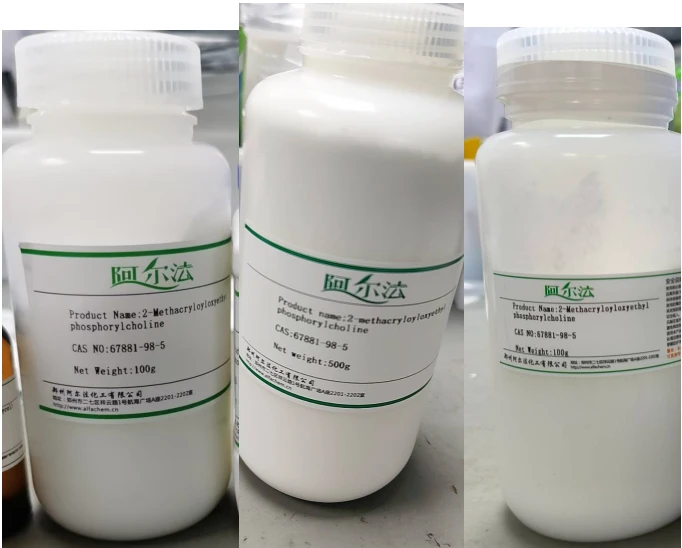
To minimize these effects, the water content in MPC (CAS 67881-98-5) should be strictly monitored, typically targeting ≤ 0.5% (Karl Fischer) for sensitive polymerizations.
▍The inhibitor paradox: Storage vs. reactivity
MPC must be stabilized to prevent spontaneous bulk polymerization during transport and storage. MEHQ (monomethyl ether hydroquinone) is commonly utilized at concentrations around ≤ 100 ppm. While essential for longevity, the concentration must be carefully balanced so it does not excessively retard your intended reaction.
Water Content (KF): Properly Stabilized (≤ 0.5%) vs Uncontrolled Storage (> 1.0%, potentially polymerized).
MEHQ Level: Properly Stabilized (≤ 100 ppm, active) vs Uncontrolled Storage (depleted/oxidized).
Polymerization Outcome: Controlled/Predictable PDI vs Uncontrolled or Failed to Initiate.
▍Practical formulation guidelines
1. Stringent Storage: Always store MPC (CAS 67881-98-5) at -20 °C under an inert gas. Allow the container to equilibrate to room temperature before opening to prevent atmospheric condensation.
2. Solvent Drying: Ensure all solvents utilized in the polymerization are of anhydrous grade and thoroughly degassed.
3. Handling the Inhibitor: Do not attempt to remove MEHQ unless strictly necessary for your specific mechanism. Instead, account for the ≤ 100 ppm MEHQ in your initiator stoichiometry calculations.
▍Manufacturing controls at Henan Alfa Chemical
To support reproducible polymerization, Henan Alfa Chemical manufactures MPC (CAS 67881-98-5) using rigorous lyophilization protocols at our facility in Zhengzhou, China. We specifically target a Karl Fischer water content of ≤ 0.5% and strictly control the MEHQ dosing at ≤ 100 ppm.
Each batch is accompanied by a batch-specific COA detailing the exact KF moisture data and NMR structural identity, allowing you to adjust your glovebox protocols and formulation accordingly. For custom packaging or to review a sample COA, please connect with our R&D team.
Need to review the actual moisture data for your next batch?
Request a sample COA or a 0.1g research sample to verify the monomer quality in your own lab.
▍Related reading
- Other material chemicals - browse related zwitterionic monomers and polymerization-grade building blocks.
- Sodium 1-Hexanesulfonate for HPLC - read our technical guide on selecting ion-pair reagents for gradient analysis.
- Contact our R&D team - discuss your specific ATRP/RAFT conditions with our technical specialists.
Share this article:
Citation: Henan Alfa Chemical R&D Team. (2026). Mitigating Trace Moisture and Premature Polymerization in MPC-Based Hydrogels. Alfa Chemical Co., Ltd. https://www.alfa-chemical.com/info/mitigating-trace-moisture-in-mpc-based-hydroge-103720422.html


