

Mitigating Trace Moisture in Ethylene Glycol Diglycidyl Ether (CAS 2224-15-9)
Nov 03, 2026
How trace water alters EEW and curing kinetics in epoxy systems, and how strict ≤0.10% moisture control from the source protects your formulation.
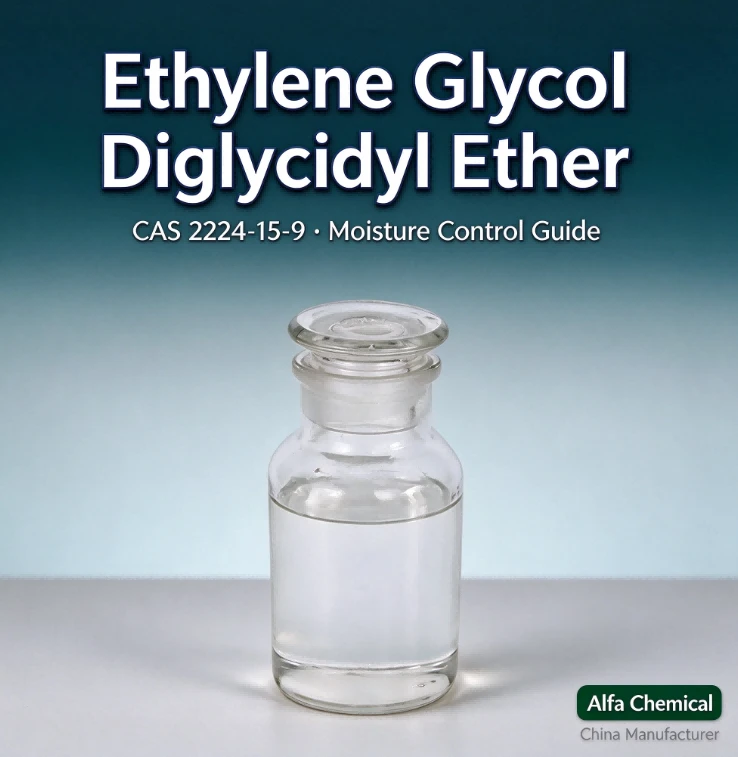
In the formulation of high-performance epoxy systems, Ethylene Glycol Diglycidyl Ether (EGDGE, CAS 2224-15-9) is widely used as a low-viscosity reactive diluent and crosslinker. While formulators focus on its low viscosity (15–30 mPa·s for high-purity grades) and difunctional reactivity (EEW 112–135 g/eq), a less visible variable often dictates the final network properties: trace moisture.
EGDGE is moderately water-soluble. Under ambient storage or improper handling, it can absorb moisture from the air. This is not merely a physical dilution issue; water participates in the chemistry of the epoxide ring, altering the stoichiometry and the curing kinetics of the system. Alfa Chemical, operating its manufacturing facility in Zhengzhou, China, controls this critical parameter at the source by maintaining a moisture limit of ≤0.10% on every commercial batch.
1. The Hydrolysis Mechanism: Why Trace Water Matters
The epoxide group in EGDGE is susceptible to nucleophilic attack by water. The rate of this hydrolysis is highly pH-dependent, being slowest at neutral pH and increasing significantly under both acidic and alkaline conditions. Illustrative stability data shows that at 25°C, the half-life of EGDGE in an acidic environment (pH 4.0) is only about 6 days, while at neutral pH (7.0) it extends to approximately 100 days.
Epoxide + H₂O → Glycol (diol)
(Catalyzed by acid or base conditions)
This reaction converts a reactive epoxy group into a non-reactive glycol. Consequently, the Epoxy Equivalent Weight (EEW) increases, meaning you need more EGDGE to achieve the same crosslink density. The result is a compromised glass transition temperature (Tg), reduced chemical resistance, and unpredictable mechanical performance.
2. Impact on Key Formulation Metrics
For formulators, the consequences of moisture ingress manifest in three critical areas:
3. Practical Mitigation Strategies
Controlling trace moisture in EGDGE requires attention at both the specification level and the processing level:
1. Specification Control: Ensure your supplier provides a batch-specific COA with a moisture limit of ≤0.10% and a hydrolyzable chloride limit of ≤0.50%. At Alfa Chemical's EGDGE product page, these limits are explicitly listed, backed by batch-specific Karl Fischer titration data and ion chromatography results.
2. Storage & Handling: Keep containers tightly sealed when not in use. Nitrogen blanketing is recommended for bulk storage tanks or large drums. For laboratory quantities, use molecular sieves to dry solvents if the EGDGE is to be diluted for formulation.
3. Processing: Avoid exposing EGDGE to open air for extended periods during weighing and mixing. If your process involves aqueous media, consider pre-dissolving EGDGE in a dry, water-miscible solvent before addition to manage the hydrolysis rate.
How Alfa Chemical Supports EGDGE Applications
Alfa Chemical manufactures high-purity Ethylene Glycol Diglycidyl Ether (CAS 2224-15-9) at our facility in Zhengzhou, China. We understand that for reactive diluents, consistency is as important as reactivity. Our standard grade maintains a moisture content of ≤0.10% and a hydrolyzable chloride content of ≤0.50%, ensuring your epoxy formulations achieve the target mechanical and electrical properties.
For formulation teams, the practical value is the data. We provide batch-specific COAs with verified EEW, viscosity, and moisture values. If your project requires a specific moisture window or a custom blend, contact our technical team with your target specification.
Need a batch-specific COA for EGDGE (CAS 2224-15-9)?
Send your target EEW and moisture limits. Alfa Chemical replies within 12 hours.
Share this article: Mitigating Trace Moisture in Ethylene Glycol Diglycidyl Ether (CAS 2224-15-9). Alfa Chemical R&D Formulation Team, November 2026. URL: https://www.alfa-chemical.com/info/mitigating-trace-moisture-in-ethylene-glycol-d-103728590.html
Disclaimer: This article is for technical reference only. The impact of moisture depends on the specific epoxy resin, curing agent, and processing conditions. Final suitability should be confirmed by the user under actual production environments. All specifications are typical ranges; batch-specific data is provided on the COA.
You Might Also Like
-

CAS:20226-99-7 | (+)-Potassium DS-threo-isocitrate Monobasic
-

CAS:764-99-8 | Diethylene Glycol Divinyl Ether
-

CAS:89331-94-2 | 2'-Anilino-6'-(dibutylamino)-3'-methylfl...
-

CAS:1071-27-8丨3-CYANOPROPYLTRICHLOROSILANE
-
CAS:28736-42-7 | 1,4-Difluoroanthraquinone
-

CAS:439089-27-7丨7-bromo-3,3-dibutyl-8-methoxy-2,3-dihydro...