



Ethylene Glycol Diglycidyl Ether | CAS 2224-15-9 | China Manufacturer
1. Product Name: Ethylene Glycol Diglycidyl Ether (EGDGE)
2. CAS Number: 2224-15-9
3. Synonym: 1,2-Bis(2,3-epoxypropoxy)ethane; Quetol 651
4. Chemical Type: Bifunctional aliphatic epoxy reactive diluent
5. Molecular Weight: 174.19 g/mol (C₈H₁₄O₄)
6. Purity (GC): Typically ≥ 97.0%
7. Epoxy Equivalent Weight (EEW): 110 – 120 g/eq
8. Inorganic Chlorine: ≤ 0.20 mg/kg (Prevents ionic corrosion)
9. Viscosity (25°C): 15 – 30 mPa·s
10. Packaging: 10g/100g (Lab Pack) | 25kg/200kg/IBC (Bulk OEM)
11. Lead Time: 3–7 business days for stock lots
12. Origin: Zhengzhou, China | COA & SDS with every shipment<
- Worldwide Delivery
- Quality Assurance
- 24/7 Customer Service
Product Introduction
CAS 2224-15-9 | Ethylene Glycol Diglycidyl Ether | Epoxy Reactive Diluent | China Manufacturer
Bifunctional Aliphatic Diepoxide · Ultra-low Viscosity · Low Chlorine Grade · High Crosslink Density
VISCOSITY (25°C)
15 – 30 mPa·s
Ultra-low dilution for EGDGE
EPOXY EQUIVALENT (EEW)
110 – 120 g/eq
Maintains crosslink density
INORGANIC CHLORINE
≤ 0.20 mg/kg
No ionic corrosion risk
PACKAGING & SAMPLE
10g – 1 Ton
Lab trial to Bulk OEM
Ready to test EGDGE (CAS 2224-15-9) in your formulation?
Get a 10g-100g lab sample of EGDGE (CAS 2224-15-9) in amber glass bottles, or request bulk pricing with batch-specific COA.
Response within 12 hours · For industrial and R&D use only.
Product Overview: CAS 2224-15-9
Ethylene Glycol Diglycidyl Ether (CAS 2224-15-9), commonly known as EGDGE, is a short-chain, water-miscible aliphatic diepoxide valued for its ultra-low viscosity and high crosslink density. Manufactured by Alfa Chemical in Zhengzhou, China, this premium epoxy reactive diluent provides aggressive viscosity reduction (down to 15–30 mPa·s) while acting as a structural crosslinker rather than a chain terminator. Unlike standard monofunctional diluents (like BGE) that soften the cured resin and drop the Heat Deflection Temperature (HDT), the bifunctional nature of EGDGE locks into the polymer network, preserving the mechanical strength and chemical resistance essential for high-performance formulations.
In sensitive applications like electronic encapsulation or high-solids coatings, trace impurities can ruin the final product. To prevent ionic corrosion of copper or silver circuitry, Alfa Chemical strictly controls the Inorganic Chlorine content of our CAS 2224-15-9 to ≤ 0.20 mg/kg through multi-stage vacuum distillation. Furthermore, by maintaining a low Hydrolyzable Chlorine (≤ 0.5%) and Water Content (≤ 0.1%), we ensure the epoxide rings remain intact during storage, preventing premature curing and guaranteeing predictable reactivity with your chosen hardeners.
Below is the detailed technical specification and the synthesis process that guarantee these critical purity levels for our EGDGE product.

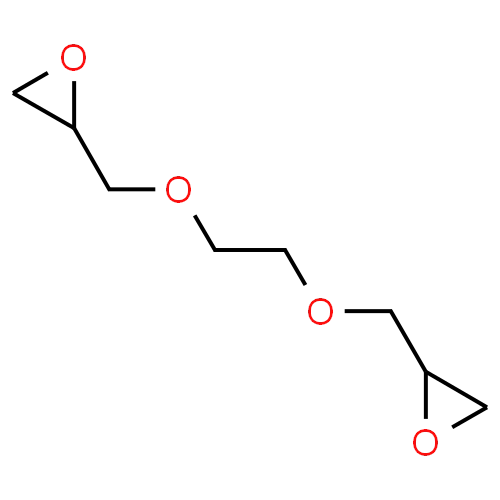
Bifunctional diepoxide EGDGE: two terminal glycidyl groups connected by a flexible C₂ ether spacer.
| Identifier | Value |
|---|---|
| IUPAC Name |
2-[2-(oxiran-2-ylmethoxy)ethoxy]methyloxirane
|
| SMILES |
C1CC1COCCOCC2CO2
|
| InChIKey |
AOBIOSPNXBMOAT-UHFFFAOYSA-N
|
Full Technical Specifications
Comprehensive physical, chemical, and stability data for EGDGE (CAS 2224-15-9). The specifications below integrate our strict factory controls to ensure reliable curing and storage stability.
Verify EEW and chlorine content on your target batch
Request a COA for CAS 2224-15-9 with measured EEW, viscosity, and Cl limits before you commit.
Synthesis Route, Process Controls & Formulation Analysis
Synthesis Route & Critical Process Controls
EGDGE (CAS 2224-15-9) is manufactured via a biphasic, phase-transfer catalyzed (PTC) reaction between ethylene glycol and epichlorohydrin (ECH) under alkaline conditions. The process window directly determines the inorganic chlorine, color, and oligomer content of the final product.

Phase-transfer catalyzed synthesis of EGDGE from Ethylene Glycol and Epichlorohydrin.
Key Synthesis Conditions:
• Catalyst: Tetrabutylammonium chloride (TBAC), phase-transfer type
• Base: NaOH in aqueous phase
• Temperature: Strictly controlled at 40°C (exothermic reaction; prevents epoxide hydrolysis)
• Critical Control: Alkalinity stoichiometry. Insufficient NaOH leaves high hydrolyzable chlorine; excess NaOH promotes oligomerization.
The "Low Chlorine" Advantage
Residual hydrolyzable chlorine originates from incomplete dehydrohalogenation. In electronic encapsulation, even trace ionic chlorine can migrate to copper or silver metallization under bias, causing corrosion-induced failure. Alfa Chemical applies multi-stage vacuum distillation to strip residual chlorine from our EGDGE, guaranteeing our standard of ≤ 0.20 mg/kg.
Formulation Analysis: EGDGE vs. Monofunctional Diluents
| Parameter | EGDGE (Bifunctional) | BGE (Monofunctional, CAS 2426-08-6) |
|---|---|---|
| Functionality | 2 (Diepoxide) | 1 (Monoepoxide) |
| Network Effect | Chain extension / Crosslinking | Chain termination |
| HDT Impact | Minimal drop | Significant decrease |
| Viscosity Reduction | 15–30 mPa·s (Sufficient) | ~2 mPa·s (Aggressive) |
Stoichiometry calculation (critical for EGDGE): EGDGE consumes hardener. For a formulation where 10 phr EGDGE (EEW 115 g/eq) is added, the added epoxy equivalents are approximately 0.087 eq per 100 g total binder (10 g ÷ 115 g/eq × 100). The hardener phr must be recalculated against the new total EEW of the blended system, not the original resin EEW alone.
Exotherm consideration: The low EEW of CAS 2224-15-9 means it introduces a high concentration of reactive epoxide groups per unit mass. In thick-section castings or large encapsulations, peak exotherm can rise. Formulators typically manage this by selecting a slower hardener or reducing accelerator loading.
Need your hardener phr recalculated for an EGDGE-modified system? Our formulation team can run the stoichiometry with your target EEW.
Request Formulation Support →Key Industrial Applications
⚡ Electronic Potting & Encapsulation
The low viscosity of EGDGE fills fine coil windings. With an Inorganic Cl ≤ 0.20 mg/kg, CAS 2224-15-9 prevents ionic migration and corrosion of Cu/Ag metallization under bias.
🧫 Composites & RTM
As an epoxy reactive diluent, EGDGE reduces resin viscosity for better fiber wet-out. Because it is difunctional (EEW 110–120), it copolymerizes into the network, avoiding the plasticization seen with monofunctional BGE.
🎨 High-Solids Coatings
Utilizing CAS 2224-15-9 achieves VOC reduction without solvent addition. Its low vapor pressure minimizes evaporative loss during application, supporting thicker single-coat build.
🧵 Textile Finishing
Water-soluble and difunctional, EGDGE enables penetration into cellulose fibers, crosslinking for durable-press and anti-wrinkle performance.
Why Choose Alfa Chemical (Manufacturer, Not a Trader)
Sourcing from a trading company introduces hidden markups, inconsistent quality, and zero technical support. As a direct manufacturer based in Zhengzhou, China, we control the entire production chain of CAS 2224-15-9 from synthesis to packaging. Here is what a direct factory partnership guarantees for your formulation:
🏭 In-House Synthesis & Distillation
We don't repackage bulk imports. We synthesize EGDGE in our own reactors and strip impurities via multi-stage vacuum distillation. This is how we guarantee the ultra-low inorganic chlorine that traders cannot verify.
🔬 Factory-Direct QC Lab
Every batch of our CAS 2224-15-9 is tested in our own QC lab (GC for purity, Karl Fischer for water, IC for chlorine). We provide batch-specific COA with measured values, not generic spec sheets copied by trading agents.
⚙️ Flexible OEM & Custom Specs
Because we are the source, we can adjust production parameters for qualified accounts (e.g., locking in a tighter EEW range for your EGDGE) or provide custom drum labeling and private branding directly from our filling line.
🧪 Real Formulation Support
When you buy EGDGE from a factory, you talk to the chemists who make it. If your hardener phr needs recalculation after adding this epoxy reactive diluent, our technical team provides the stoichiometric math, not just a sales pitch.
Packaging & Shipping
As an aliphatic diepoxide, EGDGE is sensitive to moisture, which can slowly hydrolyze the epoxide rings. We support the entire supply chain from lab R&D to multi-ton industrial production of CAS 2224-15-9, ensuring the product arrives intact.
Lab Packs (R&D)
10g / 100g Amber Glass Bottles
Nitrogen-purged | Fast DHL / FedEx dispatch
Bulk Packaging
25kg / 200kg drums
1000kg IBC totes (OEM available)
Global Freight
Air / Sea freight (FCL/LCL)
Sealed to prevent ambient moisture ingress
Frequently Asked Questions
BGE is monofunctional and acts as a chain terminator, softening the resin and lowering HDT. EGDGE is a diepoxide. It crosslinks into the matrix, reducing viscosity while better maintaining heat deflection temperature and mechanical strength. The trade-off is that EGDGE consumes more hardener.
We support both R&D and bulk production. For lab trials, you can request 10g–100g in HDPE bottles. Standard industrial MOQ is one 25kg drum. Bulk quantities (200kg, IBC) and custom OEM packaging are negotiable. Contact us with your target volume for a confirmed quotation.
Residual hydrolyzable chlorine causes ionic corrosion in electronic encapsulation (especially copper/silver metallization) and can disrupt curing kinetics with amine hardeners. Our multi-stage vacuum distillation guarantees this low level to ensure long-term electrical reliability.
Lead times depend on order volume and current inventory. Standard stock lots usually dispatch within 3–7 business days. We support flexible payment methods including T/T and L/C. Specific terms and deposit ratios are negotiable and will be finalized based on order value and contract duration.
Yes. We offer custom drum sizes and can apply your company logo and labels to drums or IBCs. Annual supply contracts and OEM arrangements are available for qualified accounts. Please reach out to discuss your specific logistical requirements.
Because EGDGE has a low EEW (110–120 g/eq), it introduces a high density of reactive groups. In thick-section castings or large encapsulations, this can elevate the peak exothermic temperature. Formulators may need to select a slower hardener or reduce accelerator loading to prevent cracking or thermal degradation.
Ready to specify EGDGE (CAS 2224-15-9) for your formulation?
Send us your target EEW range, viscosity limit, and chlorine specification. We respond with a batch-specific COA and quotation within 12 hours.
Request Technical QuotationRelated Resources
Related Epoxy Reactive Diluents
1,6-Hexanediol Diglycidyl Ether
CAS 16096-31-4 | Long-chain flexible epoxy diluent for enhanced toughness.
Neopentyl Glycol Diglycidyl Ether
CAS 17557-23-2 | Branched structure for better hydrolysis resistance.
Butyl Glycidyl Ether (BGE)
CAS 2426-08-6 | Monofunctional diluent for aggressive viscosity reduction.
About Alfa Chemical
Alfa Chemical Co., Ltd manufactures and supplies silane coupling agents, epoxy reactive diluents, and specialty material chemicals from Zhengzhou, China. We provide batch-specific COA and SDS for every shipment, with technical support for stoichiometry and formulation compatibility.
Disclaimer: For industrial and R&D use only. Not for food, consumer, or medical applications. All values shown are typical; batch-specific data is provided on the COA. Handle in accordance with SDS and local regulations.
Hot Tags: Ethylene Glycol Diglycidyl Ether | CAS 2224-15-9 | China Manufacturer, price, quotation, discount, in stock, for sale, Material Science