
The synthesis process of 1-Ethyl-3-Methylimidazolium Ethyl Sulfate Ionic Liquid
Apr 15, 2022
Introduction
Room temperature ionic liquids are composed of organic cations and inorganic or organic anions, salts in liquid state at or near room temperature, with low vapor pressure, wide electrochemical window range, high thermal stability, environmental friendliness, and easy preparation and many other features. As a new class of green solvents, ionic liquids have been widely used in many fields and rapidly developed into a research trend.
CAS 342573-75-5 1-Ethyl-3-Methylimidazolium Ethyl Sulfate ionic liquid is miscible with a variety of materials, and can be used in coatings, inks, polymer materials (especially suitable for TPU, nylon, PS/HIPS/ABS, rubber) and other industries , is a very ideal antistatic ionic liquid.
At present, 1-ethyl-3-methylimidazole ethyl sulfate ionic liquid uses N-methylimidazole and diethyl sulfate as raw materials and toluene as solvent to synthesize the target product in one step. In this paper, two synthetic processes, solvent-free and solvent-free, are mainly studied, and the most optimized synthetic route of 1-ethyl-3-methylimidazole ethyl sulfate ionic liquid is obtained by designing orthogonal experiments.
Two synthesis methods
1. Solvent-free method
Add 8.21 g of N-methylimidazole to the three-necked flask, heat the water bath to 50°C, start stirring, and add 18.48 g of diethyl sulfate (one drop every 3 seconds) dropwise to the three-necked flask using a constant pressure funnel, and the condensed water is refluxed. The reaction was kept in a dry environment and the progress of the reaction was monitored by TLC. After the reaction is complete, wash with ethyl acetate for 3 times, remove the lower ionic liquid, and evaporate the ethyl acetate under reduced pressure at 70°C to obtain a light yellow viscous liquid. Weigh and calculate yield.
2. Solvent method
Add 8.21 g of N-methylimidazole and an appropriate amount of solvent to the three-necked flask. When the temperature of the water bath reaches 50°C, start stirring. Use a constant pressure funnel to drop 18.48 g of diethyl sulfate into the three-necked flask (one drop every 3 seconds). The condensed water was refluxed, the reaction was kept in a dry environment, and the progress of the reaction was monitored by TLC. After the reaction is complete, wash with ethyl acetate for 3 times, remove the lower ionic liquid, and evaporate the ethyl acetate under reduced pressure at 70°C to obtain a light yellow viscous liquid. Weigh and calculate yield.
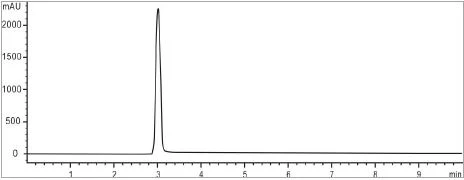
HPLC of 1-Ethyl-3-Methylimidazolium Ethyl Sulfate
Conclusion
Using N-methylimidazole and diethyl sulfate as raw materials, 1-ethyl-3-methylimidazole ethyl sulfate ionic liquid was synthesized by one-step method.
The influence of factors such as solvent, charging ratio, temperature and time on the reaction was investigated by orthogonal method, and the optimal process conditions were determined: solvent-free method, the mass ratio of N-methylimidazole and diethyl sulfate was 1:1.2, Reaction at 50℃ for 2h, the yield can reach 97.39%, and the product purity is more than 99%.
XU Chao, PAN Yao-hui
[Synthesis Process of 1-Ethyl-3-methylimidazolium Ethyl Sulfate Ionic Liquids]


![CAS 711-02-4 | Bicyclo[2.2.2]Octane-1,4-Dicarboxylic Acid](/uploads/202235855/small/cas-711-02-4-bicyclo-2-2-2-octane-1-412044887570.png?size=384x0)