
Application of Dipropylene Glycol Monomethyl Ether in Waterbased Wood Coatings
Jun 10, 2022
Introduction
The basic components of water-based wood coatings are: main film-forming substances (emulsion), film-forming aids, wetting agents, defoaming agents and fillers.
Among them, film-forming aids are also called coalescing aids, which can promote the plastic flow and elastic deformation of latex particles, improve their coalescence properties, and enable them to form films in a wide range of construction.
The selection of film-forming aids should pay attention to the following aspects:
(1) The film-forming aid must be a strong solvent for the polymer, which can effectively reduce the glass transition temperature of the polymer and has good compatibility;
(2) The solubility in water is small, and it is easy to be adsorbed by latex particles and has good coalescence performance. The film-forming aids should be concentrated in the interior of the latex particles and in the protective layer on the surface of the latex particles;
(3) Appropriate volatilization speed, in the film formation Before remaining in the coating film, its volatilization rate should be lower than that of water and ethanol, and it must be completely volatilized after film formation;
(4) It does not affect the stability of the latex system;
(5) It is safe and non-toxic to humans and animals.
In this study, alcohol ether solvents commonly used in waterborne wood coatings were selected to test the effects of two different film-forming aids - CAS 34590-94-8 Dipropylene glycol monomethyl ether (DPM), dipropylene glycol butyl ether (DPnB) on film properties, and to determine the best compounding scheme.
Effects of different coalescents on film properties
Filter the base material containing 1 000 g acrylic emulsion, 0.5% (mass fraction, the same below) BYK-346 and 0.5% BYK-024 with a 300-mesh filter cloth. Under stirring conditions, add 2% 4%, 6%, 8% and 10% of coalescing aids of the total mass of the system respectively.
After the foam disappears, the viscosity of the coating fluid is measured, and then the film is scraped (100 μm thick) to make a plate, and the film is dried at 50 °C for 1 h, the gloss and resistance of the coating film were detected, and the results are shown in below tables:
Influence of Film-forming Additives DPM on Film Performance

Influence of Film-forming Additives DPnB on Film Performance
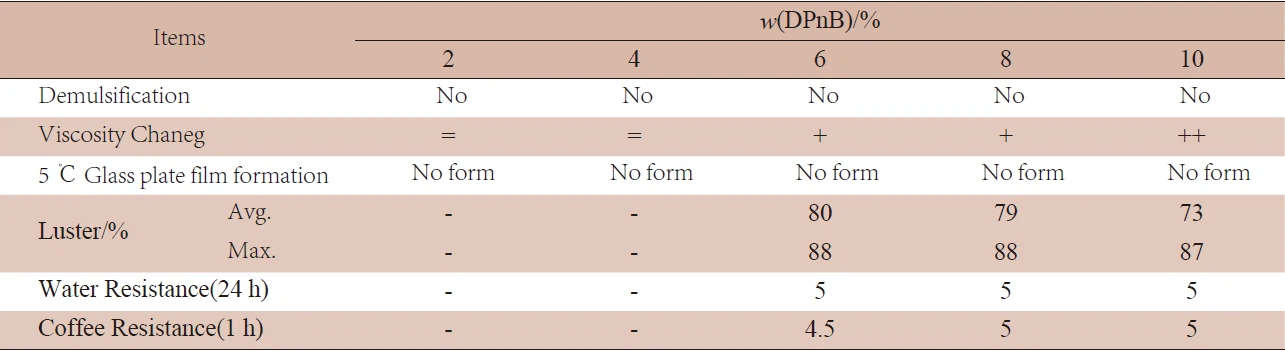
It is difficult for a single coalescent to optimize the performance of waterborne wood coatings in all aspects. Therefore, the combination of coalescents should be considered in order to obtain the best filming effect.
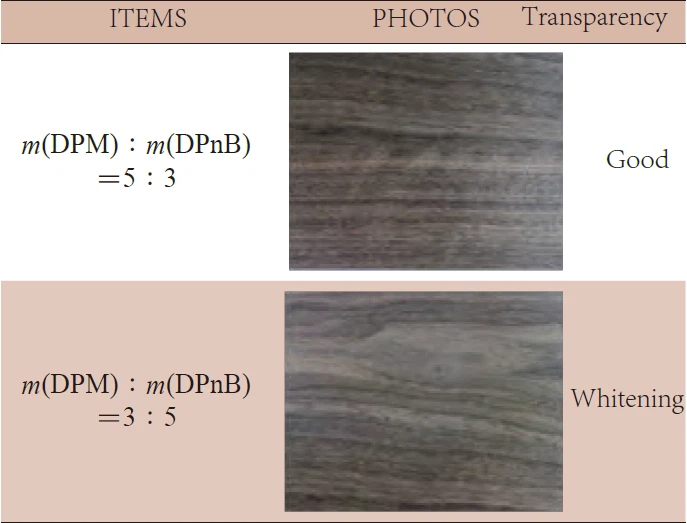
Influence of Coalescent Auxiliary Compounding Ratio on Transparency of Primer
When the water-based acrylic emulsion, 0.5% BYK-346 and 0.5% BYK-024 are used as the base materials, and the amount of the film-forming aid is 8% of the total mass of the system, the film-forming aid m(DPM):m(DPnB)= 5:3 and m(DPM):m(DPnB)=3:5 water-based transparent primer (without powder) sprayed 3 times, the dosage is 120g/m2, and dried at room temperature for 4 hours each time. The results are shown in below:
Conclusions
Considering factors such as stability, environmental protection, cost, performance and construction performance of water-based wood coatings, the combination of film-forming aids DPM and DPnB is the best choice at this stage, and the dosage and ratio are determined by specific emulsions and coating's formula.
Source:
Application of Dipropylene Glycol Methyl Ether/Dipropylene Glycol Butyl Ether in Waterborne Wood Coatings
NIE Chang-hong, ZONG Jia-huan, YUAN Ji-xian
(Jiangsu Yida Chemical Co., Ltd., Jiangyin 214441, Jiangsu, China)